
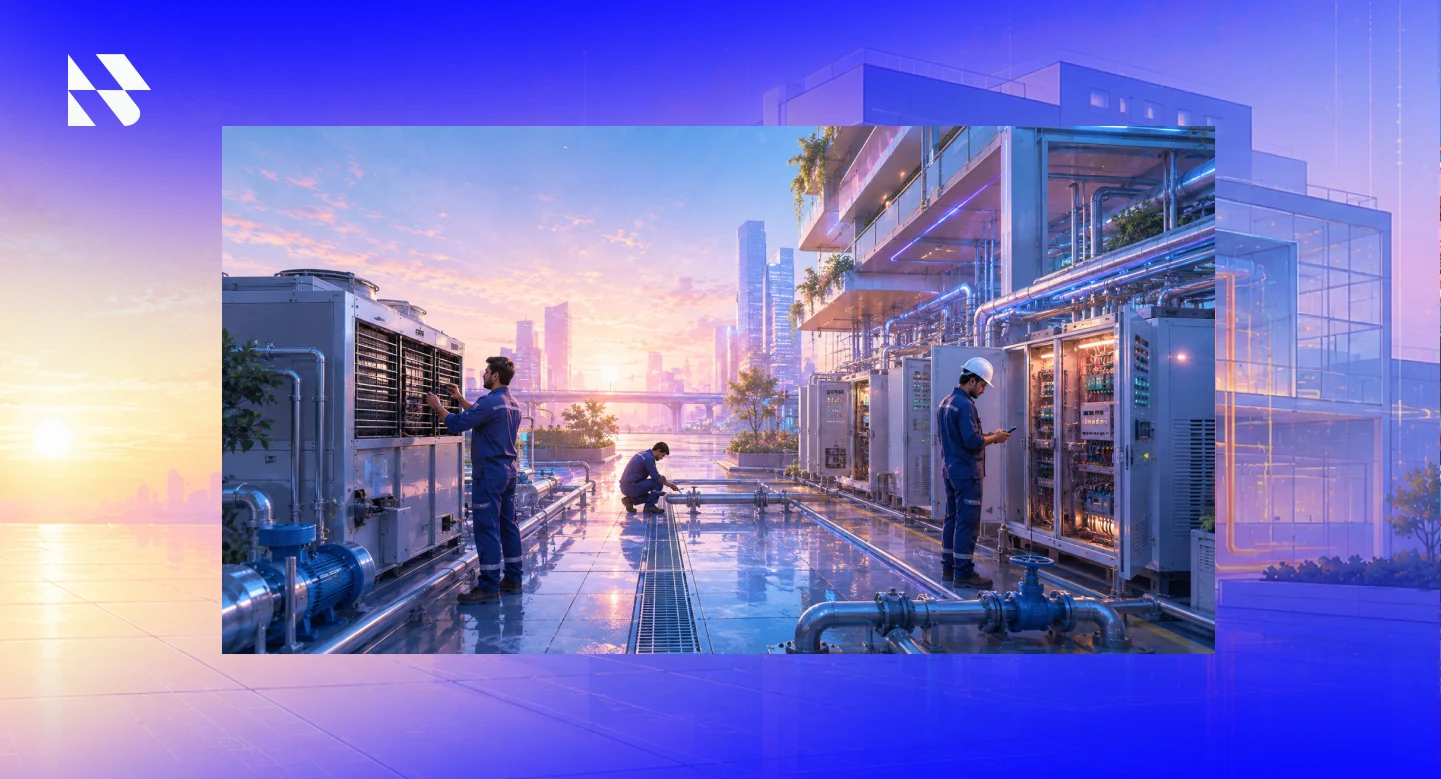
MEP services refer to the maintenance and management of mechanical, electrical, and plumbing systems within a facility. In Indian buildings, MEP services ensure HVAC, power distribution, water supply, and drainage systems operate reliably to prevent downtime.
If you manage a facility in India, you already know this truth: a building does not fail because of its walls. It fails because its internal systems stop working. The chiller trips in May when the ambient temperature hits 45°C. The sewage pump jams during a monsoon cloudburst. The DG set refuses to start the moment the grid power fails. These are not minor inconveniences. They stop production, compromise safety, and burn operating budgets.
That is why MEP services exist. Mechanical, Electrical, and Plumbing maintenance is not a background expense. It is the insurance policy for your building’s ability to function. In the current Indian FM market, hard services like MEP and HVAC hold a dominant 58.37% share. This reflects a shift in how Indian businesses view their assets moving away from “fix it when it breaks” toward “engineered uptime.”
In this guide, we will go system by system. You will learn what each part of MEP covers, how planned maintenance beats reactive repairs, and why Indian facilities need a specialized approach that differs from global templates.
The Three Pillars: What Does MEP Cover?
Let us break the three pillars down. We will focus on what a facility manager or plant head needs to observe during a morning walkthrough.
1. Mechanical Systems (The “M”)
The mechanical pillar handles all moving equipment that conditions air, moves water, or provides vertical transportation. In an Indian facility, this is often the most energy-intensive category.
- HVAC (Heating, Ventilation, Air Conditioning): This includes chillers, air handling units (AHUs), fan coil units, cooling towers, and condenser pumps. In India, HVAC systems must contend with high ambient dust, which chokes coils and reduces the heat rejection efficiency of cooling towers. Maintaining the $kW/TR$ (kilowatts per ton of refrigeration) ratio is the primary goal here.
- Elevators and Escalators: Traction drives, hydraulic lifts, and safety brakes. Beyond just movement, these require strict adherence to the National Building Code (NBC) 2016 for safety governors and emergency lowering.
- Pumps and Motors: Raw water pumps, booster pumps, and fire fighting pumps. Mechanical seals, bearings, and impellers in these units often wear out faster in humid or saline coastal regions.
- Fire Suppression Systems: Sprinkler pumps, jockey pumps, wet risers, and hydrant valves. These systems are legally mandated, yet they are often the most neglected until a fire audit or a real emergency occurs.
2. Electrical Systems (The “E”)
The electrical pillar covers generation, distribution, and backup power. In the Indian context, where grid stability fluctuates, the “E” in MEP is the literal heartbeat of the facility.
- LT and HT Panels: Low tension and high tension switchboards distribute incoming power. In high-humidity regions like Mumbai or Chennai, insulation failures and “tracking” on busbars are common risks that require periodic cleaning and tightening.
- UPS Systems: Uninterruptible power supplies are critical for sensitive equipment like servers, medical devices, or CNC machines. Battery health must be monitored through discharge tests rather than just checking voltage.
- DG Sets (Diesel Generators): Standby power for when the grid fails. A DG set that does not achieve full load within 10 to 15 seconds is a failure. Maintenance must focus on fuel quality, coolant levels, and alternator health.
- Earthing and Lightning Protection: Earth pits and surge arrestors. Many Indian buildings neglect earthing until equipment gets fried or a technician gets a shock. Testing earth pit resistance $(\Omega)$ is a non-negotiable quarterly task according to IS 3043 standards.
3. Plumbing Systems (The “P”)
Plumbing is often the “forgotten” child of MEP until a leak shuts down a server room or a sewage backup creates a PR crisis.
- Water Supply and Treatment: This includes overhead tanks, ground sumps, and Water Treatment Plants (WTP). In India, incoming water quality varies wildly; hence, filtration, softening, and RO systems must be calibrated to the specific TDS (Total Dissolved Solids) of the local supply.
- Drainage and Sewage: Gravity pipes, manholes, and Sewage Treatment Plants (STP). With tightening NGT (National Green Tribunal) norms, the operation of an STP is now a compliance necessity.
- Stormwater Management: Roof drains and collection pits. The intensity of Indian monsoons means that stormwater systems must be desilted and cleared of debris by May every year.
The Indian Reality: Why Standard Templates Fail
If you take a maintenance manual written for a London office and apply it to a factory in Pune or a hospital in Delhi, you will fail. Indian facilities face unique stressors:
- Ambient Dust Load: The high SPM (Suspended Particulate Matter) in Indian air means that HVAC filters must be cleaned three times more frequently than European standards suggest.
- Voltage Fluctuations: Our grid is prone to surges and brownouts. This puts immense stress on motor windings and electrical contactors, requiring more frequent “tightening of terminals” to prevent arcing.
- Water Hardness: Scale buildup in pipes and heat exchangers happens faster here. Without a robust “P” maintenance plan, your chiller efficiency will drop by 20% in just one season due to scaling.
Planned Preventive Maintenance (PPM) vs. Reactive Maintenance
| MEP System | Core Maintenance Activity | Environmental Stressors in India | Operational Risk of Systemic Failure |
| Mechanical (HVAC) | Descaling condenser tubes & coil cleaning | High ambient dust and hard water scaling | Increased energy consumption and potential compressor seizure |
| Electrical (Panels/UPS) | Thermal scanning & terminal tightening | High humidity and grid voltage fluctuations | Risk of insulation breakdown and unplanned power outages |
| Plumbing (STP/WTP) | Pump alignment & membrane cleaning | TDS variability and monsoon-related silt load | Compliance risk and potential for localized flooding |
| Fire Systems | Pressure testing & jockey pump audits | Internal pipe corrosion and stagnant water | Compromised emergency response during critical events |
Reactive maintenance is the “firefighting” mode. You wait for the chiller to stop, then you call a technician. By then, the damage is done. You pay for emergency parts, and you lose production hours.
Planned Preventive Maintenance (PPM) is a structured schedule of inspections. It is the difference between a minor adjustment and a total overhaul.
The Cost-Benefit Logic
Data from Indian facility operations reveals a stark contrast. Predictive and preventive approaches reduce total breakdowns by 30%. More importantly, they reduce energy costs by 15 to 20 percent because clean, lubricated, and calibrated equipment runs at its designed efficiency.
Consider a real-world scenario in a manufacturing plant. A compressor failure in a chiller might cost two lakh rupees for the part. However, the three-day production loss could cost fifteen lakh rupees. A quarterly PPM inspection costing a fraction of that amount would have identified the vibration in the bearing long before it seized.
The Role of IoT in MEP Management
We should move past the idea that IoT is “futuristic.” In 2026, it will be a standard tool for transparency. IoT in MEP means using sensors to do the talking.
- Vibration Sensors: Placed on pump motors to predict bearing failure before the human ear can hear it.
- Thermal Sensors: Placed on electrical busbars to detect “hot spots” that indicate a loose connection before it turns into a fire.
- Flow Meters: Used in plumbing to detect hidden leaks in underground lines that would otherwise waste thousands of liters of water.
Bluspring, the integrated facility management arm of Hofincons, manages MEP across more than 250 million square feet in India using this IoT-enabled approach. By merging sensor data with human expertise, they transform “maintenance” into “uptime management.” When a sensor triggers an alert, the service team receives the exact fault code and the required spare part on their mobile device before the facility manager even notices a dip in performance.
Industry-Specific MEP Challenges
Hospitals and Healthcare
In a hospital, MEP is a life-safety system. The “E” must provide dual-path redundancy to Operating Theaters. The “M” must manage negative air pressure in isolation wards to prevent the spread of pathogens. Beyond air conditioning, maintaining Medical Gas Pipeline Systems (MGPS) and ensuring HEPA filter integrity are the technical benchmarks here.
Manufacturing and Factories
The focus here is on process continuity. If a paint shop loses its ventilation for an hour, the entire batch is ruined. Electrical systems must be ruggedized to handle the “dirty power” generated by large industrial motors. Furthermore, compressed air—often called the fourth utility requires strict leak detection to prevent massive energy wastage.
IT Parks and Data Centers
Cooling and power are the only things that matter. These facilities run 24/7. A power flicker of even 20 milliseconds can crash a server rack. MEP maintenance here is about managing the PUE (Power Usage Effectiveness) and ensuring that the UPS and DG synchronization is flawless.
Pharma and Life Sciences
Pharma facilities require “Validation Maintenance.” This is not just about keeping machines running; it is about proving they run within strict parameters. Maintenance protocols must align with DQ/IQ/OQ/PQ (Design, Installation, Operational, and Performance Qualification) to meet global regulatory standards.
Regulatory Compliance and Indian Standards
A critical, yet often overlooked aspect of MEP in India is the legal framework. High-authority maintenance isn’t just about technical skill; it’s about compliance.
- Central Electricity Authority (CEA) Regulations 2010: These mandate specific safety measures for HT and LT installations. Regular audits are a legal requirement.
- Energy Conservation Building Code (ECBC): Modern MEP systems must align with these codes to ensure the facility remains energy-efficient.
- NGT Discharge Norms: For STPs, the treated water must meet specific BOD (Biochemical Oxygen Demand) and COD (Chemical Oxygen Demand) levels before discharge. Failure to maintain the “P” pillar here results in heavy litigation and fines.
How Bluspring (Hofincons) Delivers High-Authority MEP
MEP is an engineering discipline, not a janitorial one. Bluspring operates as the integrated facility management brand under Hofincons, a name synonymous with specialist engineering asset management for over three decades.
Their delivery model is built on three pillars:
- Technical Baseline Audit: Every site begins with an assessment of the health, age, and efficiency of every MEP asset.
- Site-Specific Maintenance Calendars: We do not use “copy-paste” schedules. A textile mill in Gujarat gets a different maintenance frequency than a corporate office in Bengaluru.
- Skilled Engineering Workforce: Unlike vendors who outsource labor, Bluspring focuses on trained technicians who understand the “why” behind the task.
You can explore their specific technical MEP offerings or view the broader integrated facility management scope. For a look into the engineering heritage that powers these services, visit hofincons.com.
Ensure Zero Downtime with Bluspring MEP Services
The math of maintenance is simple: you either pay for a schedule or you pay for a catastrophe. With Hard FM services making up nearly 60% of the Indian facility management market, the choice is clear.
Bluspring, backed by the engineering depth of Hofincons, provides the technical oversight needed to handle the complexities of Indian industrial and commercial buildings. We don’t just fix things; we ensure they don’t break in the first place.
Frequently Asked Questions (FAQ)
What are MEP services in facility management?
MEP services refer to the organized maintenance, operation, and repair of Mechanical, Electrical, and Plumbing systems. These services are vital for ensuring that a building remains habitable, safe, and efficient, covering everything from air conditioning to power distribution.
What does MEP stand for in buildings?
MEP stands for Mechanical (HVAC, lifts, fire pumps), Electrical (panels, lighting, generators, UPS), and Plumbing (water supply, drainage, STPs). These three systems work in tandem to support the building’s core functions.
What is the difference between MEP and HVAC maintenance?
HVAC is a subset of the Mechanical pillar. While HVAC focuses solely on air conditioning and ventilation, MEP covers the entire technical spectrum, including electrical grids and water management systems.
How often should MEP systems be maintained in India?
Given the local climate, HVAC filters should be checked monthly. Electrical panels require quarterly thermography (thermal scanning) to prevent fires. Plumbing pumps should be inspected every six months for seal wear and tear.
Why is MEP maintenance important for Indian buildings?
Indian facilities face unique challenges like extreme heat, high dust levels, and monsoon flooding. Without a dedicated MEP plan, equipment life is shortened by 40 percent, and energy costs spiral out of control due to system inefficiency.
Contact Our Engineering Team to schedule a baseline audit of your MEP systems and move from reactive repairs to guaranteed uptime.