
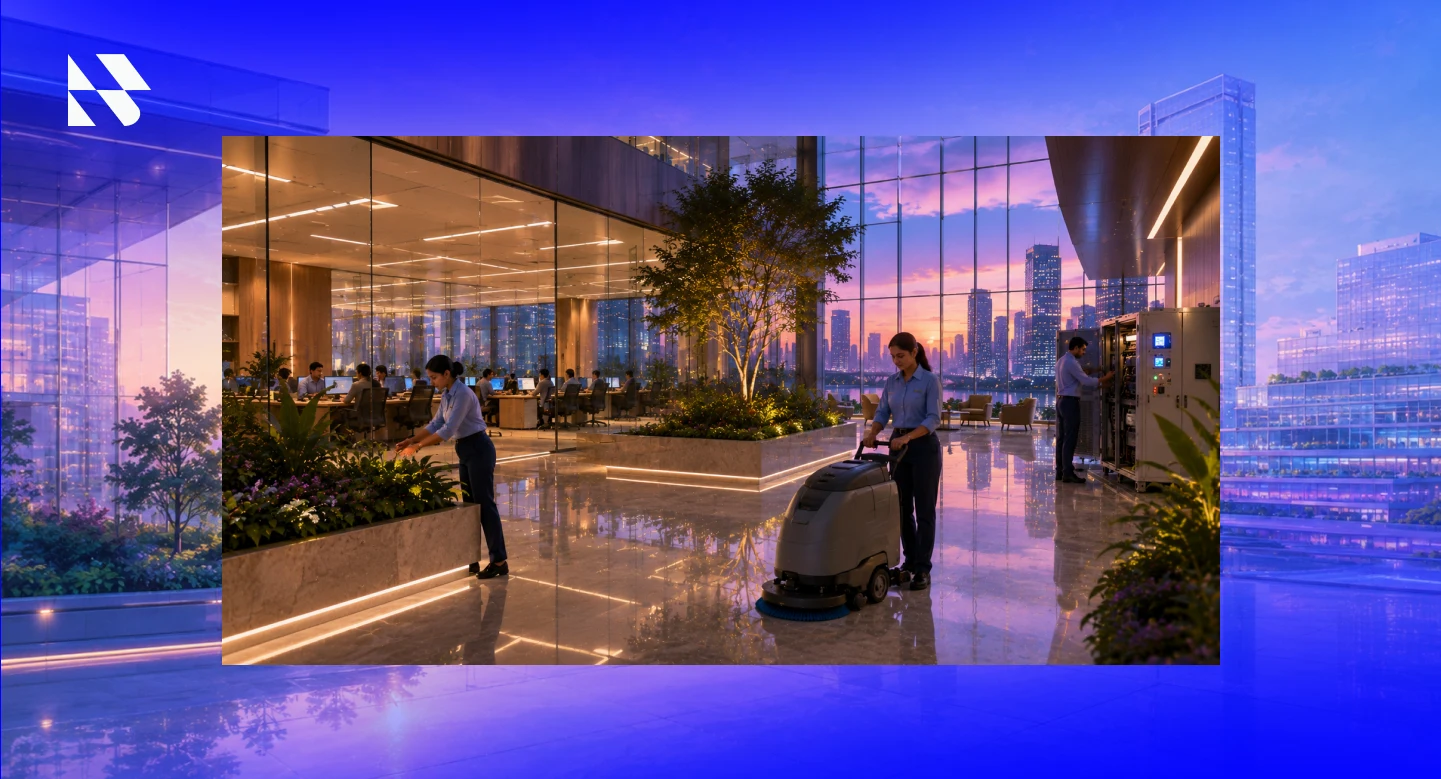
Facility management for IT parks and Global Capability Centres (GCCs) in India involves the integration of high-density housekeeping, specialized MEP uptime management, and technology-driven workplace experience services. Unlike standard office management, IT park FM focuses on 24/7 operational continuity, stringent ESG compliance, and catering to a high-density, tech-driven workforce.
The landscape of the Indian workplace has undergone a tectonic shift. While traditional corporate offices are still prevalent, the surge of Global Capability Centres (GCCs) has redefined the scale of real estate operations. In the first half of 2025 alone, GCCs accounted for 35 to 40 percent of all office leasing across India. With over 1,600 GCCs now employing nearly 2 million people, the “office” is no longer just a place of work; it is a complex ecosystem that requires an engineered approach to management.
For a VP of Administration or a Head of Real Estate at a Fortune 500 company setting up a campus in Bangalore, Hyderabad, or Pune, the stakes are high. You are not just managing a building; you are managing a hub of global innovation where a thirty-minute power fluctuation or a failure in the cafeteria’s cold chain can disrupt global workflows. This is why standard facility management is no longer sufficient. Tech campuses and GCCs require Integrated Facility Management (IFM).
The Distinctive Needs: GCC/IT Park FM vs. Standard Commercial FM
The fundamental difference lies in the intensity of usage. A standard commercial office usually operates on a 10-hour cycle with moderate footfall. In contrast, an IT park or a GCC is a living entity that rarely sleeps.
Multi-shift operations mean that the facility must maintain “Peak Hour” standards at 2:00 AM just as it does at 2:00 PM. High-density seating, often designed to maximize floor efficiency, puts immense pressure on HVAC systems and plumbing. Furthermore, multinational corporations now demand that their Indian campuses mirror their global headquarters in terms of sustainability, LEED/WELL certifications, and data security.
Why Tech Campuses Have Unique Requirements
- Invisible Operations: Cleaning and maintenance must be truly invisible. In a GCC, you cannot shut down a wing for deep cleaning at noon if a team is on a critical delivery call with San Jose or London. Maintenance windows must be surgically planned around “low-tide” occupancy hours.
- Beyond Square Footage: Traditional FM assumes a standard square footage per person. Tech campuses often double this density. This requires more frequent air changes (ACH) to prevent lethargy and higher-frequency washroom sanitization to maintain hygiene standards.
- The Data Mandate: Global mandates require real-time reporting on carbon footprints, water recycling, and waste diversion. An FM partner must be a data provider as much as a service provider, feeding information back to global HQ.
- Security Overlap: In a GCC, the boundary between facility management and data security is thin. A failure in the server room cooling is not just a maintenance issue; it is a risk to global data integrity.
The Strategic Comparison: Standard FM vs. Integrated FM for GCCs
| Feature | Standard Facility Management | Integrated FM for GCCs/IT Parks |
| Operational Hours | 10/5 (Day shift focus) | 24/7/365 (Continuous uptime) |
| Decision Making | Local/Siloed | Global Alignment (SOPs matched to HQ) |
| Service Model | Multiple vendors for different tasks | Single-point accountability (IFM) |
| Technology Use | Basic logbooks/Excel | IoT, AI-Visitor Management, Smart MEP |
| Primary KPI | Task completion | Workplace Experience & Uptime SLAs |
| Cost Impact | Hidden overheads in vendor management | 10 to 15 percent reduction in campus overhead |
6 FM Services Specific to Indian Tech Campuses
1. Smart Building Integration (IoT-Powered)
The modern tech campus is a massive generator of data. Integrating IoT sensors into the facility allows for predictive rather than reactive management. For instance, air quality sensors in high-density meeting rooms can trigger increased ventilation automatically before the room feels “stuffy.” Occupancy sensors can direct housekeeping teams to the most used areas, ensuring that labor is not wasted on empty floors while high-traffic zones remain neglected. This technology-forward approach ensures that the campus adapts to the occupants in real-time, rather than following a rigid, outdated schedule.
2. High-Density Housekeeping and Sanitization
In a campus housing 5,000 or more employees, housekeeping is an exercise in logistics. It involves “continuous loop” cleaning where high-touch points like elevator buttons, cafeteria tables, and door handles are sanitized every hour. For GCCs, this also includes specialized cleaning for sensitive areas like data labs, hardware testing bays, and server rooms where microscopic dust control is paramount. The use of mechanized cleaning equipment, autoscubbers and high-pressure steam cleaners—is non-negotiable to maintain Grade-A office standards without unnecessarily increasing headcount.
3. AI-Powered Visitor Management and Security
Security at an IT park is no longer just about a guard with a paper register. Solutions like SeQure provide AI-powered visitor management that integrates with the building’s access control systems. This ensures a seamless entry experience for global executives while maintaining a digital audit trail that meets international compliance standards. The goal is a frictionless journey from the parking gate to the boardroom, where the visitor feels welcomed rather than interrogated.
4. Cafeteria and Food Services at Scale
The cafeteria is the heart of the tech campus. Managing food services for corporates with thousands of employees involves complex supply chain management, constant cold-chain monitoring, and diverse menu planning that caters to a multicultural workforce. Integrated FM providers manage the kitchen infrastructure, gas safety, and grease-trap maintenance, ensuring that the food service is a highlight of the employee experience. This includes managing peak-hour flows during lunch and ensuring late-night shift workers have access to the same quality of nutrition as the day shift.
5. MEP and Technical Uptime SLAs
Mechanical, Electrical, and Plumbing (MEP) systems in a GCC are mission-critical. A failure in the UPS system or a leak in the precision air conditioning (PAC) units of a server room is catastrophic. Tech campuses require specialized MEP teams that operate on strict Service Level Agreements (SLAs). This includes 100 percent power redundancy and real-time monitoring of DG sets to ensure they achieve full load within the required 10-second window during a grid failure. In 2026, we measure success by “Availability” metrics if a system is at 99.9% uptime, it is still failing the requirements of a top-tier GCC.
6. Compliance, ESG, and Governance Reporting
Multinational GCCs operate under global ESG (Environmental, Social, and Governance) mandates. They need an FM partner who can provide documented proof of water saved through STPs (Sewage Treatment Plants), energy saved through HVAC optimization, and 100 percent compliance with local labor laws. This reporting is often integrated into global dashboards for the parent company. If your FM partner cannot provide a digital report on your carbon diversion for the month of May, they are not meeting the basic requirements of a modern tech campus.
The Geography of Demand: Bangalore, Hyderabad, and Pune
The demand for specialized IT park FM is concentrated in India’s primary tech hubs. Each city presents a unique challenge:
- Bangalore: As the silicon valley of India, it has the highest density of GCCs. The challenge here is often water self-sufficiency and navigating complex logistics for campus supplies. Campuses like IIM Bangalore or the massive hubs in the Outer Ring Road require massive infrastructure support that goes beyond just “maintenance.”
- Hyderabad: Known for sprawling, large-scale campuses and high-end “Grade-A” assets. The focus here is often on managing massive centralized HVAC systems and maintaining LEED Platinum standards across millions of square feet.
- Pune: A growing hub for automotive R&D and specialized tech GCCs. The focus in Pune is often on integrating “Lab-style” MEP with high-end corporate office standards, requiring a technician who understands both a circuit board and a chiller.
The shift toward Grade-A offices in these cities is driving the need for sophisticated IFM. A single IFM vendor can reduce a tech campus’s operational overhead by 10 to 15 percent simply by eliminating the “silo effect” where different vendors for cleaning, security, and maintenance work at cross-purposes.
Case Study: Bluspring’s Impact on Tech Campuses
Bluspring has established itself as a leader in managing complex, high-stakes environments. Their portfolio includes iconic institutions like IIM Bangalore and high-growth tech leaders like InMobi.
The Bluspring approach is built on a “Specialist First” mindset. Rather than providing a generalist manager for a tech campus, they deploy engineering-led teams. For a client like InMobi, where the workplace culture is agile and fast-paced, the FM delivery must be equally dynamic. This involves integrating workplace experience apps with hard FM services. For example, if an employee reports a temperature fluctuation in a meeting room via their mobile app, the system triggers a technician’s workflow before the admin team even needs to intervene.
You can learn more about their approach to managing corporate environments at integrated facility management corporate-spaces or explore their specific geographic expertise in the Bangalore region at integrated infrastructure services
The Strategic Shift: From Facility Management to Workplace Experience
In 2026, the role of an FM partner for a GCC has evolved. You are no longer hiring someone to simply “keep the lights on.” You are hiring someone to ensure that your employees are productive, your global standards are met, and your operational risks are mitigated.
When a GCC head looks at their Indian operations, they want to see the same level of sophistication they would find in a San Francisco or London office. Integrated Facility Management provides that bridge. It turns the facility from a passive cost center into a strategic asset that helps in talent retention. In a market where developers are in high demand, a well-managed cafeteria, a seamlessly functioning smart building, and a clean, safe environment are core components of the “Employee Value Proposition.”
Manage Your Tech Campus with Bluspring
The complexity of managing a Global Capability Centre or a sprawling IT park in India requires more than just a headcount; it requires an engineered system. With the GCC sector driving nearly 40 percent of the Indian office market, the competition for talent is fierce. The quality of your facility is a direct reflection of your brand’s commitment to its people.
Stop managing a patchwork of vendors and start managing an integrated ecosystem. Bluspring, backed by the heritage of Hofincons and a specialist approach to corporate spaces, ensures that your tech campus remains a hub of productivity and innovation with zero downtime.
To explore how our integrated infrastructure services can support your expansion in India’s tech hubs, visit integrated infrastructure services or check our comprehensive service list at integrated facility management. For cafeteria and hospitality excellence, see our Food & Hospitality services.
Frequently Asked Questions (FAQ)
What is facility management for IT parks in India?
It is a specialized branch of IFM that focuses on the 24/7 operational needs of technology campuses. It includes high-density housekeeping, mission-critical MEP maintenance, smart building management, and large-scale food and hospitality services.
How do GCCs manage their facilities in India differently?
GCCs often use an Integrated Facility Management (IFM) model to ensure global SOPs are followed. They prioritize ESG compliance, data security, and high-tech visitor management, often consolidating all services under one vendor to reduce overhead and improve accountability.
What FM services do tech campuses need for sustainability?
Tech campuses require comprehensive waste management, STP/WTP (Sewage/Water Treatment Plant) operations, and real-time energy monitoring. An FM partner must provide detailed ESG reports to track the campus’s progress toward net-zero goals and LEED certifications.
Why do IT parks outsource facility management?
Outsourcing to a specialized IFM provider like Bluspring allows IT companies to focus on their core software or R&D work. It also reduces operational costs by 10 to 15 percent and ensures that the facility is managed by technical experts who can handle the complexity of Grade-A infrastructure.
What is the role of technology in tech campus FM?
Technology acts as the backbone. It includes IoT sensors for predictive maintenance, AI-driven visitor management systems, and centralized digital dashboards for tracking service requests and energy consumption across the entire campus.