
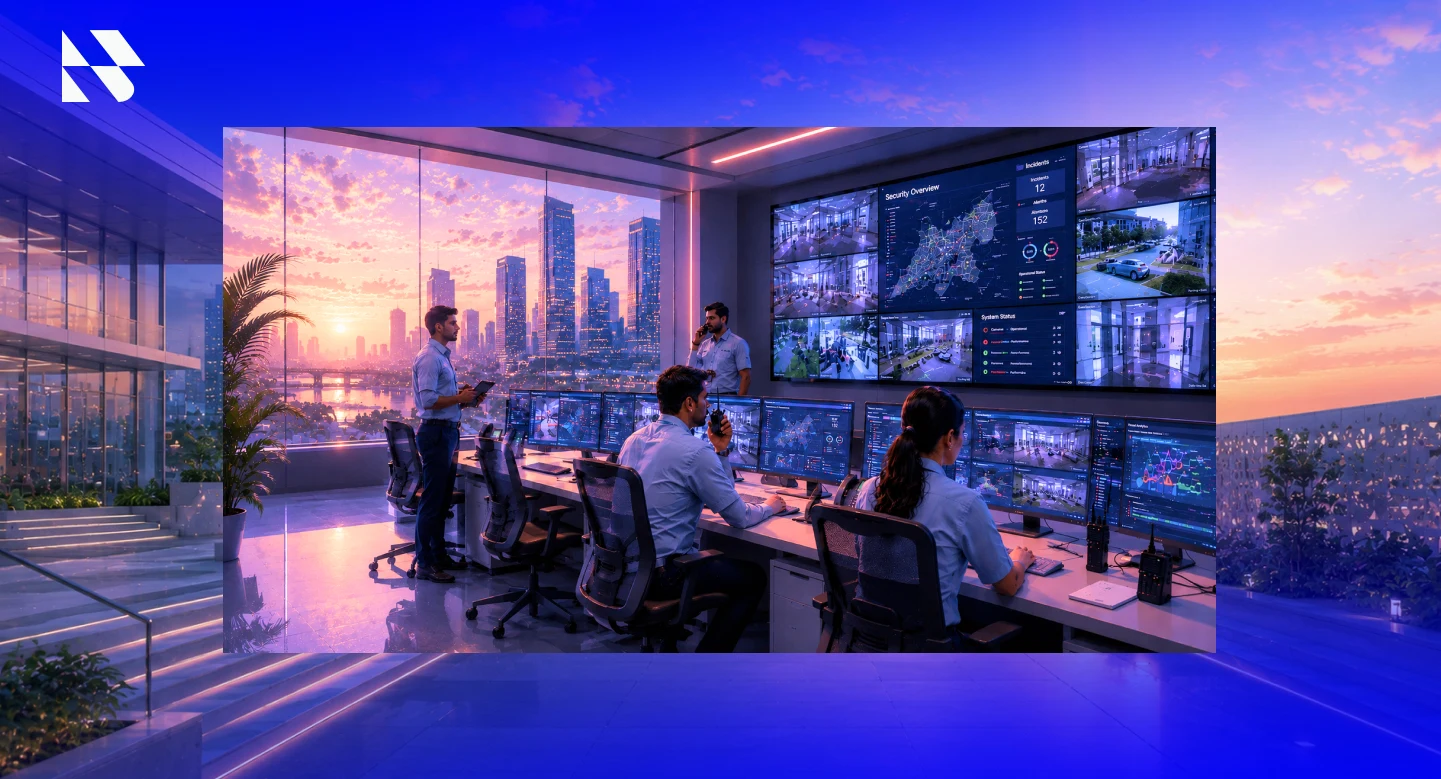
Corporate security challenges across India are rapidly evolving past traditional defensive measures. Large enterprise campuses, multi-tenant IT parks, and heavy industrial facilities are dealing with an increasingly complex risk landscape. Modern threats span physical unauthorized entry, sophisticated asset theft, operational data vulnerabilities, and severe statutory compliance failures.
In this heightened risk environment, relying on standalone, unmonitored security guards at perimeter gates is no longer sufficient to protect expansive corporate spaces.
Integrated security services for enterprises in India combine trained physical guarding with advanced digital surveillance and automated access technologies into a single, unified framework. Unlike fragmented setups where manual guards, standalone CCTV cameras, and physical visitor logs operate in isolated silos, an integrated model ensures that physical and electronic elements work in tandem to detect, prevent, and respond to security threats in real time.
According to deep-dive market research from Credence Research, security services represent the most popular and rapidly expanding market segment within the broader Indian facility management industry. As organizations face stricter compliance rules and shifting physical safety threats, security heads, admin VPs, and corporate campus managers are actively moving away from piecemeal vendors.
Instead, they are choosing comprehensive, integrated solutions to safeguard their workforce, secure intellectual property, and preserve expensive physical assets.
Integrated Security vs Standalone Guarding: The Strategic Pivot
For several decades, corporate security management in India relied almost entirely on manual gatekeeper roles. While manned guarding services India remain a critical foundation of any physical safety strategy, relying on physical guards alone introduces clear vulnerabilities. Human error, fatigue-related blind spots, and slower communication chains during localized emergencies can leave an enterprise exposed.
An integrated security approach transforms corporate defense from a reactive, labor-heavy cost center into a data-driven operational asset. By layering smart technology over physical presence, enterprises gain complete visibility over every square foot of their facility.
For enterprises looking to move beyond standalone guarding, integrated security services bring physical security personnel, electronic surveillance and access technologies into a coordinated security framework.
The comparison table below details the strategic and operational differences between traditional standalone guarding and modern integrated security services:
| Operational Parameter | Standalone Guarding | Integrated Security Services |
| Core Architecture | Relying solely on physical security personnel at entry, exit, and patrol points. | A unified mix of licensed manned guarding, electronic access control, and AI analytics. |
| Data & Visibility | Paper-based visitor registers, unmonitored CCTV storage, and siloed incident reporting. | Real-time dashboards, automated alerts, digital visitor logs, and unified command centers. |
| Response Mechanism | Reactive; relies on a guard noticing an issue and manually raising an alarm. | Proactive; sensors and AI cameras detect anomalies early, triggering automated incident protocols. |
| Compliance Management | High risk of manual errors, non-verified staff deployment, and uneven training. | Strict compliance with statutory guidelines, verified licensing, and digital audit trails. |
| Resource Efficiency | Relies heavily on adding headcount, leading to high labor costs and fatigue-related gaps. | Optimized workforce footprints supported by technology, lowering long-term operating costs. |
The Full Scope of Enterprise Security Services
Building a resilient corporate security framework requires establishing multi-layered protection that covers a facility from its outer perimeter to its interior core zones. A comprehensive integrated security model features six essential service lines designed to keep day-to-day enterprise operations running smoothly:
Security support within facility management can extend across guarding, access control, surveillance, emergency response and risk management, helping organisations address security as part of their wider facility operations.
1. Trained & Licensed Manned Guarding
Manned guarding in facility management goes far beyond checking vehicles or issuing parking tokens at an entry gate. Modern enterprise guarding demands highly disciplined, physically fit, and thoroughly verified security personnel who can handle diverse, high-pressure responsibilities.
These guards manage active perimeter patrolling, supervise emergency evacuations, provide first-aid response, and execute control room monitoring duties. To operate legally and effectively across various states in India, all guards must undergo structured training under strict national regulatory frameworks. This ensures they possess clear expertise in crowd management, emergency fire safety, and corporate hospitality etiquette.
2. Access Control Systems
Securing a corporate perimeter requires managing exactly how people and vehicles move inside a facility. Access control systems for enterprises include heavy-duty turnstiles, biometric scanners, contactless RFID smart cards, and ANPR (Automatic Number Plate Recognition) cameras for basement and surface parking areas.
These electronic systems ensure that employees, vendors, and temporary contractual workers only enter zones that match their specific security clearance levels. This completely eliminates unauthorized wandering while generating a reliable, time-stamped digital record of all indoor movements.
3. CCTV & Surveillance Operations
A corporate surveillance system is only as valuable as the actionable information it provides in real time. Integrated security links high-definition IP cameras distributed across a facility back to a central, high-tech Command Center. Dedicated security teams monitor strategic areas, perimeter walls, blind spots, and material movement zones.
Instead of reviewing hours of recorded footage after an asset goes missing or an incident occurs, operators monitor live feeds supported by automated software alerts that instantly flag unusual activity, such as blocked fire exits, tailgating at turnstiles, or perimeter fence breaches.
4. AI-Powered Visitor Management
Traditional paper registers at the front reception desk create major security gaps, illegible logs, and long check-in wait times during peak morning hours. Modern enterprise operations require advanced digital frameworks like SeQure, an AI-powered visitor management and access control app.
The SeQure application automates visitor pre-registration via host invites, facilitates facial recognition check-ins at entry kiosks, issues instant digital badges, and sends real-time host notifications upon arrival. This digital approach removes manual logging errors, flags overstaying visitors, and maintains secure, cloud-based logs required for statutory corporate audits.
5. Emergency Response Protocols
An integrated security framework includes clearly mapped, highly detailed emergency response protocols for a wide variety of critical scenarios, including fire outbreaks, natural disasters, medical crises, or external civil unrest.
On-site security teams receive rigorous training to coordinate seamlessly with local law enforcement, municipal fire departments, and emergency medical services. Regular scheduled mock drills, clear luminescent evacuation paths, and automated public address systems ensure that large, multi-floor workforces can be organized and moved safely during a sudden facility crisis.
6. Risk Assessment & Audits
Security is a continuous, evolving process rather than a static hardware installation. Regular risk assessments and comprehensive security audits help enterprise leaders identify hidden physical gaps, vulnerable perimeter walls, outdated software patches, and operational protocol weaknesses.
Expert security consultants evaluate the facility’s specific risk profile against local regional crime patterns and internal corporate workflows, allowing management to update security infrastructure before vulnerabilities can be exploited by bad actors.
Why AI-Powered Security is a Game-Changer
AI-powered security for facilities fundamentally changes how enterprises manage risk by shifting the entire operational focus from historical investigation to real-time, proactive prevention. Incorporating smart artificial intelligence tools like the SeQure application adds a layer of intelligent automation that manual human monitoring alone cannot match.
Predictive Threat Detection
AI analytics software can monitor hundreds of live video feeds simultaneously to detect pre-defined suspicious behaviors, abandoned or unattended baggage in common areas, or individuals loitering near restricted server rooms. When an anomaly is detected, the system automatically alerts the nearest patrol guard via their mobile device, saving vital minutes.
Elimination of Tailgating
Traditional access cards cannot prevent a second unauthorized individual from slipping through a secure door or turnstile immediately behind an authorized employee. AI-linked surveillance cameras recognize tailgating violations instantly, capturing the individual’s profile and alerting the central command center to deploy an immediate physical check.
Touchless, Secure Authentication
Advanced facial recognition algorithms speed up entry protocols for thousands of corporate employees during morning rush hours. This technology eliminates physical contact points, matching high throughput speed with absolute verification standards against the company’s HR database.
Data-Driven Guard Deployment
AI systems analyze historical incident logs, guard tour records, and facility footfall patterns to map out localized risk trends. This analytics-driven insight helps facility managers deploy physical security patrols precisely where and when they are needed most, maximizing resource efficiency.
Regulatory Requirements for Security Agencies in India
Operating an enterprise-grade corporate security apparatus requires strict, uncompromised adherence to Indian labor laws and national security legislation. Choosing a non-compliant or unverified third-party vendor can expose an enterprise to severe legal liabilities, heavy financial penalties, and immense corporate reputational damage.
The Critical Importance of the PSARA Licence
Any agency providing private security guards or security systems in India must hold a valid, active licence under the Private Security Agencies (Regulation) Act, 2005 (PSARA). This state-specific statutory licence ensures that the security agency complies with strict government mandates regarding:
- Complete Background Verification: Executing absolute police background verification and detailed biometric profiling of all security guards through local law enforcement authorities before deployment.
- Financial and Labor Compliance: Verifying the agency’s financial health, strict Provident Fund (PF) contributions, Employee State Insurance (ESI) filings, and minimum wage compliance.
- Mandatory Physical Training: Adhering to government-mandated physical training regimes, physical fitness criteria, operational uniform guidelines, and maximum weekly working hour limits.
- Structured Security Training: Providing structured classroom and field training programs covering comprehensive fire fighting, crowd control, emergency response, and first-aid execution.
When evaluating a corporate security services India partner, inspecting and verifying their state-specific PSARA licences is the single most critical compliance step for admin heads, legal teams, and security directors.
How Terrier Delivers Tech-Enabled Enterprise Security
Delivering reliable, fully compliant, and highly scalable security services across complex enterprise layouts, sprawling manufacturing zones, and multi-location IT infrastructure requires an operational partner with deep regulatory grounding and national execution capability.
Terrier stands out in the Indian market as one of the country’s leading licensed security services providers. Operating as a specialized sub-brand powered by Bluspring, Terrier bridges the operational gap between physical on-ground guarding and digital asset protection.
Scalable Human Capital & Strict Compliance
Bluspring supports large-scale corporate operations with a massive, highly disciplined workforce of 91,000+ trained professionals, including fully licensed, police-verified security guards. This extensive national talent pool allows Terrier to deploy compliant, uniform security teams quickly across multiple corporate office locations, ensuring complete operational continuity even during sudden organizational scale-ups or facility expansions.
Direct Technology Integration
Terrier combines its reliable physical guarding services with smart, proprietary prop-tech applications like SeQure. By deploying SeQure’s AI-powered visitor management and access control app across client premises, Terrier replaces slow, error-prone manual front-gate tasks with accurate digital visitor tracking, facial-recognition attendance logging, and automated material gate passes.
Unified Command Operations
Terrier’s advanced security approach connects on-ground guarding teams directly with remote electronic monitoring infrastructure. If a perimeter laser sensor trips at midnight or an AI-enabled camera flags a tailgating incident at a restricted lab door, the alert goes simultaneously to the on-site guard’s handset and Terrier’s central command operations team. This dual-layered monitoring framework ensures a rapid, highly coordinated response to any corporate threat.
This connected approach reflects the broader role of infrastructure security systems, where physical protection, electronic monitoring and operational processes work together to strengthen security across complex facilities.
Frequently Asked Questions (FAQ)
What does integrated security mean for large corporate enterprises?
A centralized command center brings together CCTV surveillance, access control, visitor management, and on-ground security operations into a single monitoring hub. By providing real-time visibility across all security systems, it enables faster incident detection, coordinated responses, and better decision-making while maintaining a complete audit trail.
Why is a PSARA licence mandatory for security providers in India?
The Private Security Agencies (Regulation) Act (PSARA) is a strict legal mandate enforced by the government of India. It ensures that security providers follow mandatory guidelines for complete police verification of guards, verified physical training, minimum wage standards, and structured operational compliance to prevent illegal security operations.
How does the SeQure app improve corporate front-desk security?
SeQure is an advanced AI-powered visitor management tool that completely replaces traditional paper guest registers. It automates visitor tracking through digital pre-registration, secure facial recognition check-ins, and instant host alerts, ensuring unalterable, cloud-based logs are available for internal security audits.
What is the role of manned guarding in a tech-enabled security setup?
While digital technology excels at continuous threat detection, automated tracking, and rapid alerts, trained physical guards remain indispensable. Human personnel are required to physically respond to alerts, manage emergency evacuations, handle unexpected medical crises, and provide a reassuring visible deterrent on the ground.
Can an integrated facility management partner manage food services?
Yes. By deploying electronic access control systems and automated AI surveillance to secure lower-risk zones or internal corridors, enterprises can optimize their physical guard deployments. This strategic realignment reduces total labor overhead while simultaneously improving overall 24/7 security coverage.
Secure your premises with trained, tech-enabled teams
Protecting your corporate employees, sensitive intellectual property, and high-value physical assets requires an optimal balance of disciplined physical guarding and intelligent digital technology. Ensure your enterprise facilities stay secure, fully compliant with national regulations, and operationally resilient against evolving risks.