
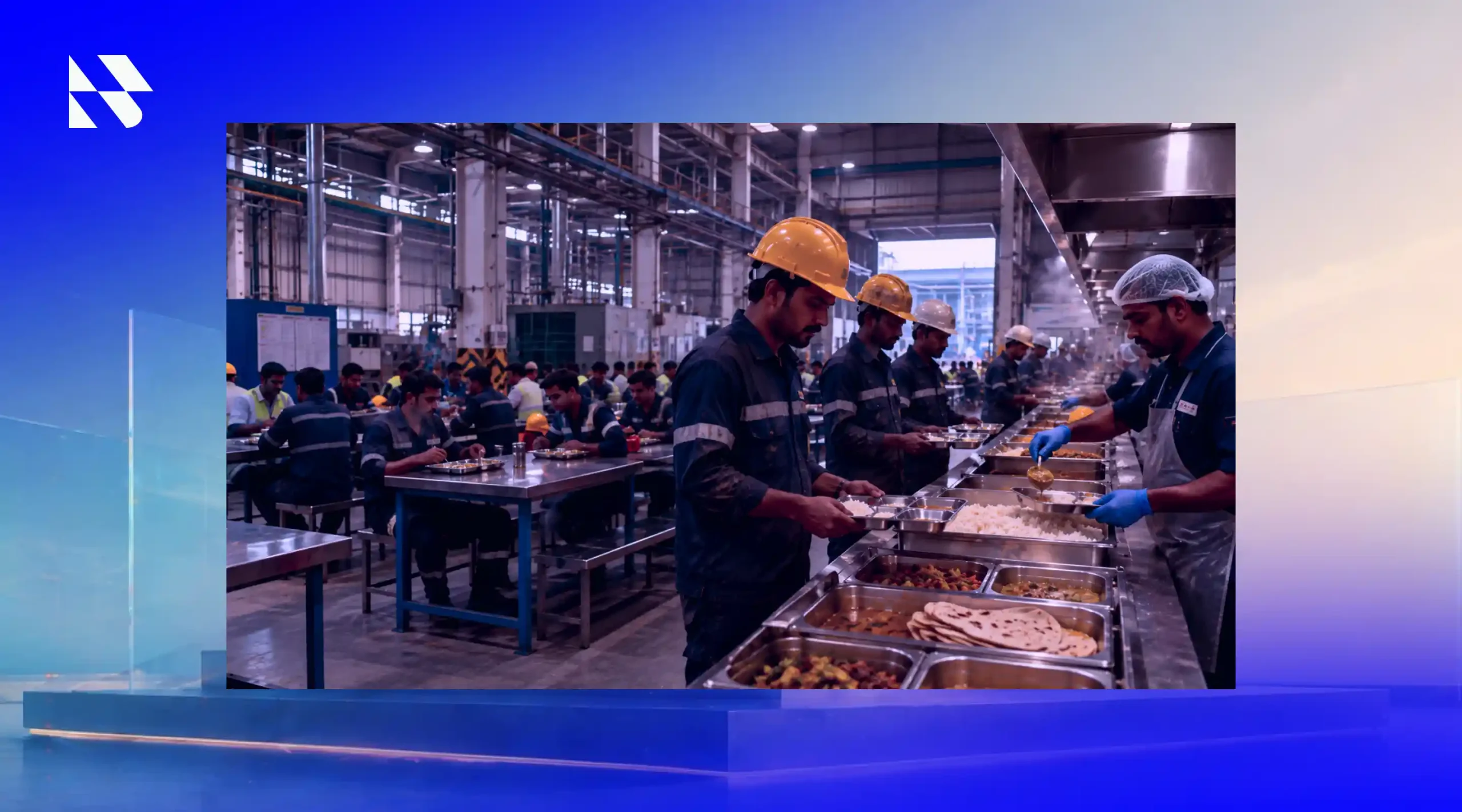
Oorja is Bluspring’s dedicated industrial food service brand for manufacturing plants, factories, and heavy industrial sites, built around high-calorie, high-sustenance meals rather than the light, desk-focused menus suited to corporate offices. It’s designed specifically for continuous 24×7 rotating shift operations, ensuring a worker on a 2 a.m. shift receives the same freshness, temperature, and portion size as someone eating on the main day shift.
Why Industrial Food Needs Differ From Office Food
A corporate office menu built around light, gut-friendly meals that avoid an afternoon slump makes sense for desk-based knowledge work. It makes very little sense for someone on their feet for eight or twelve hours running a production line, operating heavy machinery, or doing sustained physical labour.
Manual and shift-based industrial work has fundamentally different nutritional demands than office work:
- Higher caloric requirements — physically demanding work burns significantly more energy than sedentary desk work, and a light meal that suits an office worker will leave a factory worker under-fuelled well before their shift ends
- Sustained energy over long shifts — industrial shifts often run eight, ten, or twelve hours, requiring meals that provide steady energy rather than a quick, light lunch designed around a short midday break
- Round-the-clock operations — many plants run continuously across day, night, and rotating shifts, meaning “lunch” isn’t a single fixed event but a meal service that has to function at full standard at every hour of the day
- Physical safety considerations — workers operating machinery or performing physical tasks need consistent, reliable nutrition; being under-fed or served inconsistent food quality isn’t just a morale issue on a factory floor, it has real safety implications
Because of this, Oorja is built specifically around the nutritional and operational realities of industrial workforces, rather than adapting a corporate cafeteria model with larger portions.
Core Scope: What Oorja Delivers
High-calorie, traditional menus. Oorja’s menu design favours familiar, high-energy, traditional food — the kind of substantial, satisfying meals that match the physical demands of manual and shift-based work — over the lighter, globally-inflected menus built for desk-based corporate teams.
24×7 rotating shift consistency. Industrial catering under programs like Oorja operates across continuous 24×7 rotating shifts, ensuring workers on a 2 a.m. shift receive the same temperature, freshness, and portion sizes as those on the main day shift. This is one of the most operationally demanding aspects of industrial food service — it requires kitchen staffing, food preparation timing, and quality control to function identically at 2 a.m. as they do at 1 p.m., with no quiet assumption that night-shift workers will accept a lesser standard.
Large-batch kitchen logistics. Feeding a large industrial workforce across multiple shifts requires kitchen infrastructure built for volume and speed without sacrificing food safety or quality — batch cooking schedules, hot-holding protocols that maintain both temperature and freshness, and portion consistency across hundreds or thousands of servings per shift.
Shift-ready service formats. Industrial meal service has to fit around production schedules rather than the other way around — meaning service windows, queue management, and food readiness are designed around when a shift actually breaks, not a fixed office-style lunch hour.
Nutritional adequacy for physical labour. Beyond calorie count alone, Oorja’s menu planning accounts for the broader nutritional needs of physically demanding work — adequate protein, sustained-energy carbohydrates, and hydration-supportive elements suited to workers spending long hours on their feet or operating machinery, often in physically demanding plant environments.
How Industrial Canteens Serve Rotating Shifts Consistently
Serving a night shift to the same standard as a day shift is harder than it sounds, and it’s where many generalist catering operations fall short. A few operational disciplines make it possible:
Staffing the kitchen for every shift, not just peak hours. A canteen that quietly reduces staffing or cooking standards for the night shift will produce a visibly different meal experience for those workers — Oorja’s model requires full kitchen operation across every shift window, not a skeleton crew overnight.
Standardising recipes and portioning across shifts. Consistency depends on documented recipes, portion standards, and quality checks that apply uniformly regardless of what time the meal is served, removing the variability that comes from different cooks or teams working different shifts with different informal standards.
Building supply chains around continuous operation. Ingredient freshness for a 2 a.m. meal depends on procurement and storage planning that accounts for round-the-clock usage, not a delivery schedule built around a single daytime service window.
Monitoring feedback across all shifts, not just the day shift. Worker feedback and quality checks need to genuinely cover night and rotating shifts, since these are also the workers most likely to be overlooked in a canteen operation that isn’t deliberately designed to serve them equally.
What Plant HR Heads Should Evaluate in an Industrial Catering Partner
Industrial catering has a wider gap between vendors who claim 24×7 capability and vendors who can genuinely deliver it than most other institutional food categories. A few questions help plant HR and admin managers tell the difference before signing a contract, not after workers start complaining about the night shift.
Can the vendor show actual night-shift staffing levels, not just a service commitment on paper? A canteen that’s fully staffed on day shift but runs with a skeleton crew overnight will produce a visibly worse meal experience for night-shift workers, regardless of what the contract promises.
Are portion sizes and recipes standardised and documented, or does quality depend on which cook happens to be on duty for a given shift? Consistency at scale requires standardisation, not individual cook discretion varying shift to shift.
Does the vendor have experience specifically with continuous-operation plants, or is round-the-clock catering a stretch beyond their usual single-shift office or campus contracts? Running food service across three rotating shifts is a materially different operational problem than a single daytime lunch service, and experience in one doesn’t automatically transfer to the other.
How does the vendor handle supply chain planning for off-hours freshness? Ask specifically how ingredients are stored and rotated to support a 2 a.m. meal with the same freshness as a 1 p.m. one — vague answers here usually mean the night shift is quietly getting a lower standard.
Is there a structured feedback loop that actually reaches night and rotating-shift workers? Many canteen feedback systems default to day-shift-only mechanisms — a suggestion box only checked during office hours, or surveys timed around the day shift — which systematically excludes the workers most likely to be underserved.
Plants that evaluate a catering partner against these questions before signing tend to avoid the more disruptive alternative: discovering the night-shift gap only after it shows up in worker complaints, morale issues, or a safety incident tied to inadequate nutrition.
How Oorja Ties Into Bluspring’s Broader Plant Soft-Services Offering
Industrial food service doesn’t operate in isolation from the rest of a plant’s facility operations. Oorja is designed to work alongside Bluspring’s broader soft-services and technical facility management offerings for industrial and manufacturing sites — including engineering and asset management support delivered through Bluspring’s Hofincons subsidiary — so that plant HR and admin teams aren’t managing food service as a disconnected vendor relationship separate from the rest of their facility operations.
For industrial plants and manufacturing sites running continuous shift operations, this coordination matters in practice: canteen scheduling, housekeeping, and technical facility upkeep all need to function on the same round-the-clock rhythm, and a food programme built by an operator who already understands industrial-scale, continuous-operation facility management tends to integrate more smoothly than a standalone catering contract layered on top.
Frequently Asked Questions (FAQ)
What is Oorja by Bluspring?
Oorja is Bluspring’s dedicated food service brand for manufacturing plants and industrial sites, delivering high-calorie, traditional meals built for continuous 24×7 shift operations rather than standard office-style catering.
What is a high-energy food program for factory workers?
A high-energy food program is a meal service designed around the higher caloric and sustained-energy needs of manual and shift-based labour, offering substantial, traditional meals rather than the lighter menus suited to desk-based office work.
How do industrial canteens serve rotating shifts consistently?
Industrial canteens maintain consistency across rotating shifts by staffing kitchens fully at every shift window, standardising recipes and portioning, and building supply chains that support round-the-clock freshness rather than a single daytime service peak.
Why do manufacturing plants need a different food program than offices?
Manufacturing and industrial work involves higher physical exertion, longer shifts, and round-the-clock operations, all of which require higher-calorie, more substantial meals and a service model built for continuous rather than single-shift operation.
Does Oorja support night-shift and rotating-shift workers equally?
Yes — Oorja’s model is specifically built to ensure workers on night and rotating shifts receive the same freshness, temperature, and portion standards as day-shift workers, rather than treating off-hours service as a lower priority.
Fuel Your Workforce, Every Shift
A physically demanding job deserves food that actually sustains it — at 2 a.m. as much as at 2 p.m. Oorja by Bluspring delivers high-calorie, traditional meals built for continuous industrial operations, consistent across every rotating shift.