
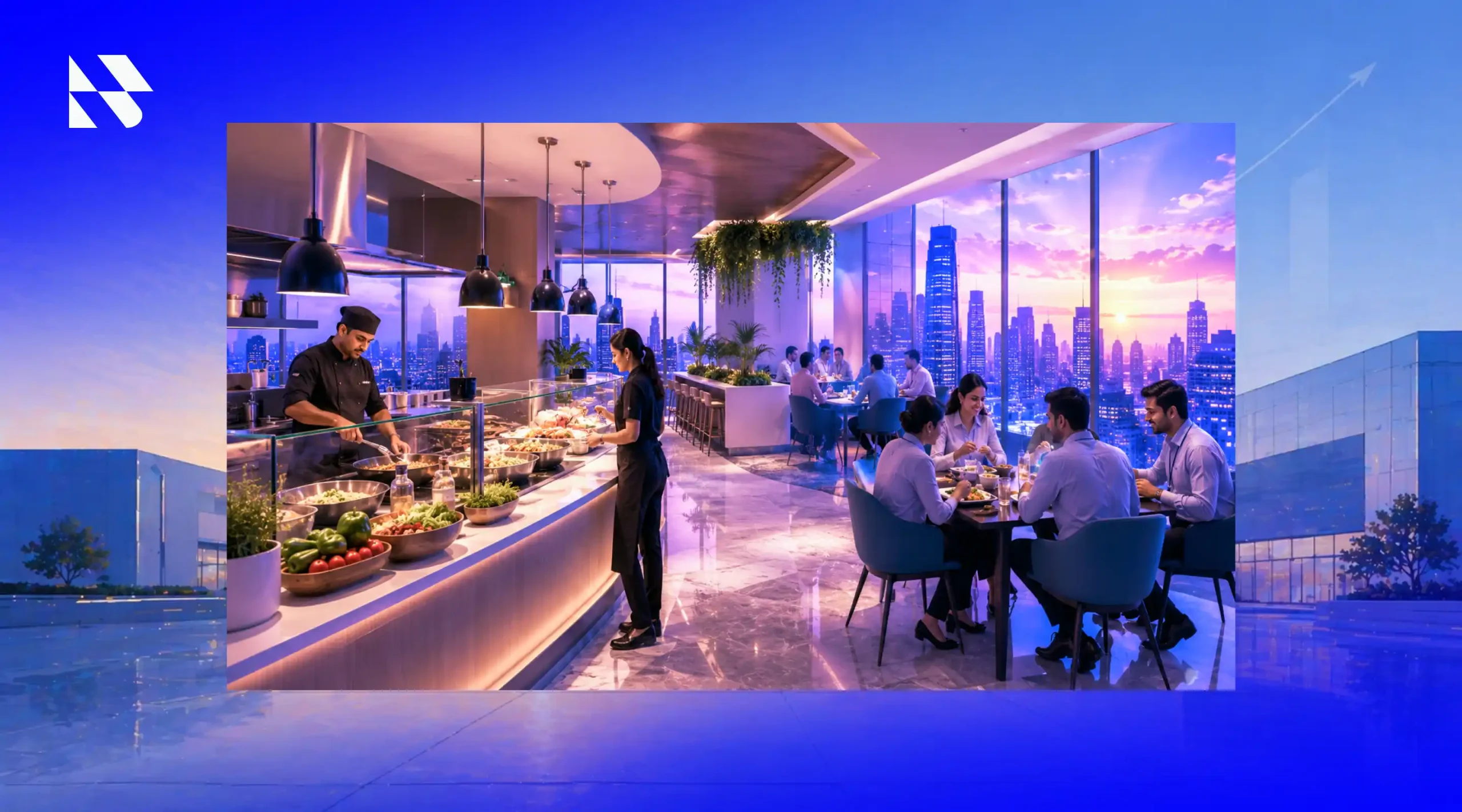
Navya is Bluspring’s dedicated corporate dining brand, built specifically for corporate offices and Global Capability Centres (GCCs) rather than factories, campuses, or hospitals. It focuses on light, global cuisine and gut-friendly preparations designed to keep employees mentally sharp through the afternoon, delivered through live cooking counters, café-style integration, and a menu that rotates on a 30-day cycle to avoid the fatigue that comes with repetitive cafeteria food.
What Navya Is and Who It Serves
Bluspring runs its Food & Hospitality business through a set of dedicated brand frameworks, each built for a specific setting rather than applying one generic catering model everywhere. Navya is the framework built for corporate office environments and GCCs — the fast-moving, largely desk-based, hybrid-work workplaces where lunch is squeezed between meetings and a heavy meal can cost an employee their entire afternoon.
This is a deliberate departure from how institutional catering services traditionally works. A factory floor, a hospital ward, and a corporate GCC don’t have the same dietary needs, meal timing patterns, or expectations of the dining experience — so Navya is designed around what a corporate workplace specifically needs, rather than being a scaled-down version of a broader catering contract.
Menu Philosophy: Light, Global, Gut-Friendly
The single biggest complaint HR and admin teams hear about office cafeterias isn’t taste — it’s the 3 p.m. slump. Heavy, oil-laden, carbohydrate-dense meals are a well-known productivity drain in desk-based work, and Navya’s menu philosophy is built specifically to avoid it.
That translates into a few consistent choices:
- Lighter preparations — reduced reliance on heavy oils and processed carbohydrates in favour of preparations that don’t leave employees sluggish after lunch
- Global cuisine rotation — menus draw from a mix of regional Indian and international cuisines, giving GCCs and multinational offices in particular a dining experience that reflects a genuinely global workforce
- Gut-friendly formulations — an emphasis on fresh, digestion-friendly ingredients rather than the deep-fried, reheated staples common in older-generation cafeteria models
- Balance over restriction — the goal isn’t a “diet menu,” but a working balance between indulgent options and lighter fare so the cafeteria still feels like a genuine perk, not a wellness mandate
The underlying logic is straightforward: food eaten at 1 p.m. shows up in performance at 3 p.m., and a corporate dining services programme should be judged on both.
Operational Model: Live Counters, Café Integration, and Menu Rotation
Menu philosophy only matters if the operational model can deliver it consistently, at scale, every single day. Navya’s operating model is built around three components.
Live cooking counters. Rather than pre-plated, mass-cooked meals sitting under heat lamps, live counters let employees see food prepared fresh in front of them — a format that both improves perceived food quality and gives the cafeteria some of the energy of an actual restaurant rather than an institutional canteen.
Café-style integration. Navya blends traditional cafeteria service with café-style formats — grab-and-go counters, beverage stations, and lighter all-day options — reflecting how hybrid-work employees actually eat through the day, rather than assuming everyone wants a single sit-down lunch service.
30-day menu rotation. Corporate cafeteria menus under programs like Navya rotate over a 30-day cycle to prevent menu fatigue, balancing regional Indian palates with global cuisine choices that support sustained afternoon focus. A repeating weekly menu is one of the most common reasons cafeteria satisfaction scores decline over time — a longer rotation window keeps the offering feeling fresh without requiring an unmanageable, constantly-changing menu that’s hard to plan or source consistently.
Why Hybrid Work Has Changed What Employees Expect From Office Food
Office food used to compete with home cooking and nearby restaurants on convenience alone. In a hybrid-work model, it competes with an employee’s decision to come into the office at all.
When attendance is a choice rather than a default, the cafeteria becomes part of the case for showing up — alongside collaboration, culture, and in-person interaction. A tired, repetitive, heavy-lunch cafeteria doesn’t just generate complaints; it quietly erodes one of the reasons an employee chooses to be on-site on a given day. This is particularly pronounced in GCCs, where the workforce often skews younger, more globally aware in its food preferences, and more willing to compare the office cafeteria against the wider food scene it has easy access to outside.
That shift is why the standard for office dining has moved from “adequate and hygienic” to something closer to a hospitality-grade experience — and why a dedicated, purpose-built programme like Navya, rather than a generic catering add-on, has become the more competitive option for enterprises trying to make in-office days genuinely appealing.
Beyond the Menu: Consistency, Hygiene, and Service at Scale
A strong menu concept only holds up if the execution behind it is consistent — across every site, every day, and every shift change in the kitchen. For enterprises running cafeterias across multiple office locations, a few operational factors matter as much as the food itself.
Hygiene and food safety discipline. Corporate cafeterias sit under the same food-safety expectations as any commercial food-handling operation — proper cold-chain handling, kitchen sanitation, and staff hygiene training that doesn’t lapse when a menu gets more ambitious.
Staffing and service consistency. Live counters and café-style formats depend on trained service staff who can maintain the same standard of speed and presentation whether it’s a quiet Tuesday or a packed all-hands week. Inconsistent staffing is one of the more common reasons an otherwise well-designed cafeteria programme underperforms in practice.
Feedback and menu iteration. A 30-day rotation only stays effective if it’s actually being refined — tracking which dishes get repeat orders, which counters see the most footfall, and adjusting the next cycle accordingly, rather than running the same rotation indefinitely on autopilot.
Billing and vendor coordination. For sites with subsidised or paid meal models, a smooth billing system integrated into the daily service experience avoids one of the most common friction points in corporate dining — long queues or clunky payment processes undercutting an otherwise good meal.
Because Navya operates within Bluspring’s wider Food & Hospitality and Integrated Facility Management infrastructure, these operational layers — hygiene compliance, staffing, and service consistency — are managed with the same institutional discipline Bluspring applies across its other service lines, rather than as a standalone catering arrangement bolted onto a facility.
How Navya Fits Within Bluspring’s Food & Hospitality Vertical
Navya is one of several dedicated brand frameworks inside Bluspring’s Food & Hospitality business, each built for a distinct setting — corporate offices and GCCs through Navya, alongside other frameworks purpose-built for campuses, healthcare, and industrial sites. This sector-specific model means the culinary approach, menu design, and service format are built around the realities of each environment, rather than a single catering contract stretched across very different occupant needs.
For enterprises evaluating a cafeteria partner, this matters operationally: a corporate office or GCC gets a dining programme designed specifically around desk-based hybrid work, backed by the sourcing, kitchen infrastructure, and culinary operations of a facilities business already running food service at national scale.
Frequently Asked Questions (FAQ)
What is Navya by Bluspring?
Navya is Bluspring’s dedicated corporate dining brand for offices and GCCs, focused on light, global, gut-friendly menus delivered through live counters and café-style service formats.
What does Navya's corporate dining program include?
It includes a rotating 30-day menu spanning regional and global cuisines, live cooking counters, café-integrated service formats, and a menu philosophy built to avoid the afternoon sluggishness that heavier cafeteria food typically causes.
How is corporate cafeteria food designed for hybrid workplaces?
Hybrid-workplace cafeteria design prioritises lighter, faster, and more flexible formats — grab-and-go options alongside sit-down service — that fit the way employees actually move through an in-office day, rather than a single fixed lunch service.
What makes GCC cafeteria menus different in India?
GCC workforces tend to have more globally exposed food preferences and higher day-to-day expectations shaped by the broader food scene around them, which pushes cafeteria programs toward more international menu variety and a more premium, café-like experience.
How often does the Navya menu change?
Navya menus rotate on a 30-day cycle, long enough to avoid repetition fatigue while remaining operationally manageable to plan, source, and execute consistently across sites.
Bring Your Office Cafeteria Back to Life
A hybrid workplace needs a reason for people to want to be there, and lunch is a bigger part of that decision than most enterprises give it credit for. Navya by Bluspring brings a light, global, gut-friendly dining programme to corporate offices and GCCs — built to keep employees energised through the afternoon, not just fed.