
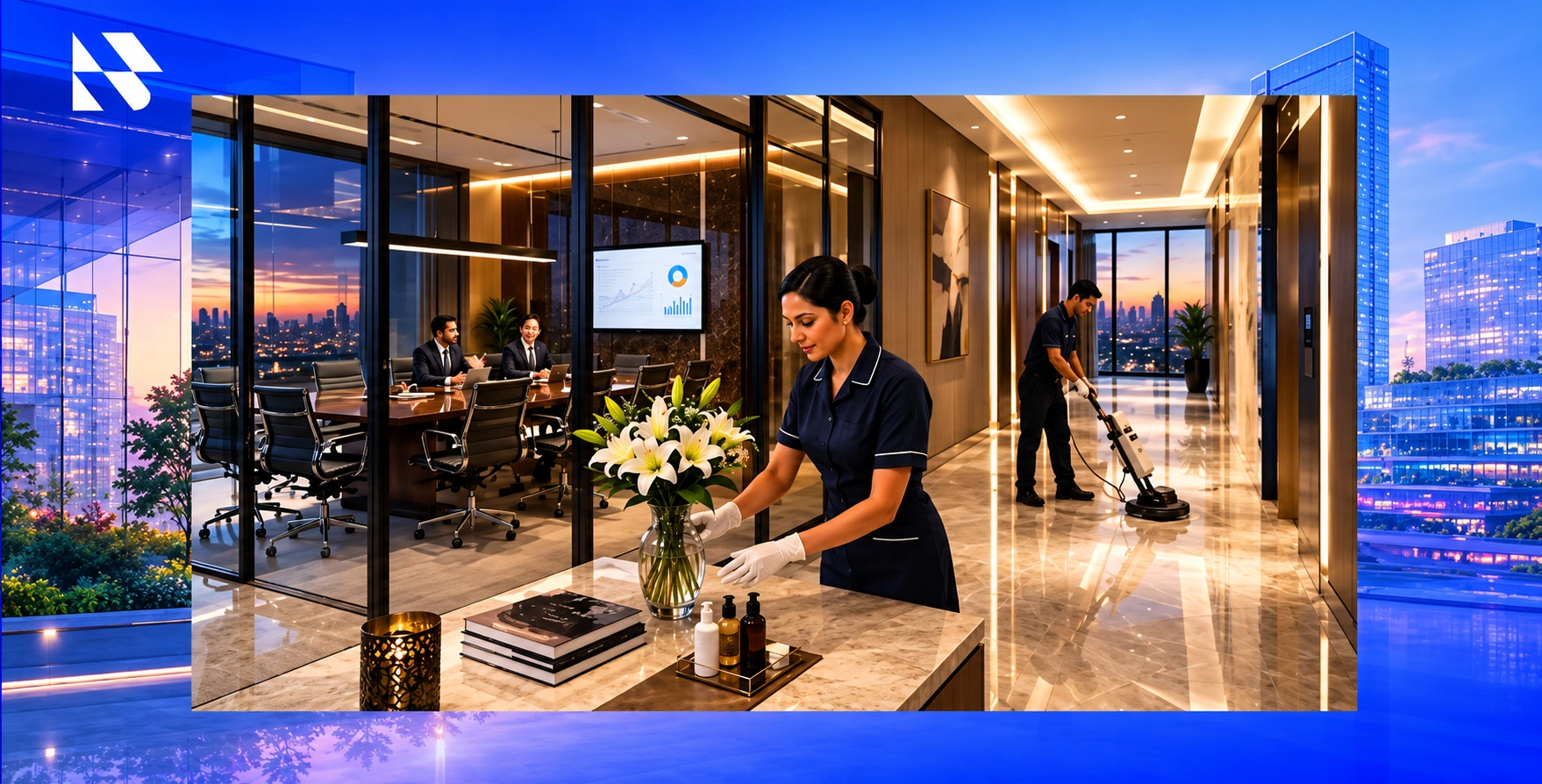
Executive housing facility management is the dedicated Integrated Facility Management (IFM) service that runs long-term corporate residences for senior leadership, expatriates, and relocating executives — combining hospitality-grade housekeeping, maintenance SLAs, security coordination, and concierge-style support. It exists because leadership housing carries different service expectations than transient employee accommodation: longer tenancies, family occupancy, and a much higher bar for discretion and consistency.
Why Enterprises Need a Dedicated Model for Leadership Housing
When a company relocates a CXO, an expatriate hire, or a senior leader to a new city, the housing that comes with the role is rarely a short-term arrangement. Tenancies typically run for a year or more, often with a spouse and children in residence, and the standard of service expected is closer to what a five-star hotel would offer than what a standard corporate guest house provides.
This creates a set of operational demands that generic housekeeping or facility upkeep contracts aren’t built for:
- Long-term tenancy management — coordinating leases, renewals, and vendor continuity over months or years, not days
- Discretion — service staff working inside a family’s home need training in confidentiality and protocol, not just cleaning standards
- Consistency of standards — the same quality of housekeeping, linen, and turndown service every day, not just for a single stay
- Family-oriented needs — school-run coordination, dietary preferences, and household routines that don’t exist in a transient guest house
Enterprises that try to manage this through a standard facilities vendor, or through informal arrangements, typically run into inconsistent service quality, slow maintenance turnaround, and — because there’s no single point of accountability — a steady stream of small frictions that erode a senior hire’s experience of relocation. A dedicated executive housing model exists specifically to remove that friction.
There’s also a cost dimension enterprises often underestimate. A poorly managed executive residence doesn’t just create day-to-day friction — it shows up as higher attrition risk for hard-to-replace senior hires, repeated emergency repair costs from deferred maintenance, and HR teams spending disproportionate time firefighting household issues instead of focusing on the relocation itself. A dedicated executive housing model is, in that sense, as much a retention tool as it is a facilities service.
Core Scope of Executive Housing Facility Management
A properly structured executive housing facility management service covers four connected areas, delivered under a single point of accountability rather than split across multiple uncoordinated vendors.
Housekeeping to five-star standards. This goes beyond routine cleaning — it includes linen and wardrobe care, kitchen and pantry management, and the kind of daily presentation standard associated with luxury hospitality rather than office housekeeping.
Maintenance response SLAs. Long-term executive residences need defined response windows for plumbing, electrical, HVAC, and appliance issues. A dedicated model builds these SLAs specifically around a single-family residence, where a delayed repair isn’t just an inconvenience — it directly affects a senior leader’s ability to work and live comfortably.
Security coordination. Executive housing typically works alongside a residence’s existing security arrangement — coordinating access control, visitor management, and daily protocols with the household rather than replacing dedicated security services outright.
Concierge-style support. From coordinating vendors and service appointments to managing day-to-day household logistics, concierge support is what turns a managed residence into a genuinely hospitality-grade living experience rather than a well-maintained apartment.
Long-term executive accommodation carries different service expectations than short-stay guest housing, which is why maintenance response time and housekeeping discretion for family-occupied residences need to be built into the SLA from the start, rather than added after service gaps show up.
Onboarding and transition support. The move-in period is where most service failures originate — mismatched expectations, unclear points of contact, or a household that hasn’t been properly briefed on protocols. A structured onboarding process, including a documented handover with the incoming family and a clear escalation contact from day one, avoids the early missteps that otherwise take months to correct.
How Enterprises Should Evaluate an Executive Housing Partner
Not every facilities vendor that offers “residential services” is set up to run executive housing well. A few questions are worth asking before signing:
- Is there a single point of accountability, or will housekeeping, maintenance, and security be managed by three separate teams with no shared reporting line?
- Are maintenance SLAs residence-specific, with response times suited to a single occupied home, rather than generic commercial-facility timelines?
- Is staff trained specifically for household and family settings — confidentiality, protocol, and the softer skills that hospitality-grade service requires — rather than trained only for commercial cleaning?
- Is there a reporting cadence that gives HR or admin teams visibility into service quality, open issues, and resolution times, rather than a “call if something breaks” arrangement?
Enterprises that ask these questions upfront tend to avoid the service gaps that otherwise surface six months into a leadership relocation, once the honeymoon period of a new posting has worn off.
How This Differs From Guest House Management
It’s worth being precise about the distinction, because the two services are often confused.
Guest house management is operational and employee-focused. It’s built for transient occupancy — employees on short business trips, training assignments, or temporary postings — where the priority is efficient turnover, consistent basic amenities, and cost-effective operation across multiple short stays.
Executive housing is built around a single occupant or family over an extended period. The priorities shift from turnover efficiency to continuity, discretion, and a premium standard of daily living. A guest house is optimised for many short stays; an executive residence is optimised for one long one, done consistently well.
Conflating the two — or trying to run executive housing through a guest-house-style operating model — is one of the more common reasons enterprises see service quality drop for their senior leadership housing.
For a deeper comparison, see our guide to executive housing vs guest house management and how the operational requirements differ.
How Bluspring’s Executive Housing Service Is Structured
Bluspring Executive Housing service is designed around the operational realities above: a single point of accountability, hospitality-trained housekeeping staff, defined maintenance SLAs specific to residential settings, and coordinated security and concierge support.
As part of Bluspring’s broader Integrated Facility Management portfolio — which also covers Soft Services, Security Support, Technical MEP, Landscaping, and Guest House Management — Executive Housing draws on the same operational infrastructure and vendor network used across Bluspring’s other IFM services, while running as a distinct, dedicated service line built specifically for senior leadership accommodation. That combination gives enterprises a single accountable partner for leadership housing, backed by the scale and consistency of a listed, national-level IFM provider.
Because Executive Housing sits within a wider IFM organisation rather than operating as a standalone residential agency, enterprises also gain continuity when a senior leader’s needs change — for example, if a relocation later requires coordination with Bluspring’s Security Support or Technical MEP teams, the same account structure carries across rather than requiring a fresh vendor relationship.
Frequently Asked Questions (FAQ)
What is executive housing in facility management?
Executive housing is a dedicated IFM service category that manages long-term residential accommodation for senior corporate leadership, combining hospitality-grade housekeeping, maintenance SLAs, security coordination, and concierge support under a single accountable provider.
How do enterprises manage long-term housing for senior leadership?
Most enterprises engage a dedicated executive housing provider rather than a generic facilities vendor, so that housekeeping, maintenance, and security are coordinated as one continuous service built around a single residence and occupant, rather than fragmented across multiple contracts.
What standards apply to executive corporate residences?
Executive residences are typically held to hospitality-grade standards — five-star housekeeping, defined maintenance response times, and consistent daily service quality — rather than the baseline standards applied to standard office or guest-house facilities.
How is executive housing different from a guest house?
Guest house management is built for short-term, high-turnover employee stays, while executive housing is built for extended, often family-occupied tenancies where continuity, discretion, and premium daily service matter more than turnover efficiency.
Who typically uses executive housing services?
CXOs, expatriate hires, and senior leaders relocating to a new city for an extended assignment are the typical occupants, often alongside their families.
Give Your Leadership a Home, Not Just an Address
Senior leadership relocation is disruptive enough without inconsistent housekeeping, slow maintenance, or uncoordinated security. Bluspring’s Executive Housing service is built to remove that friction — so your leadership team can focus on the job, not the household.