
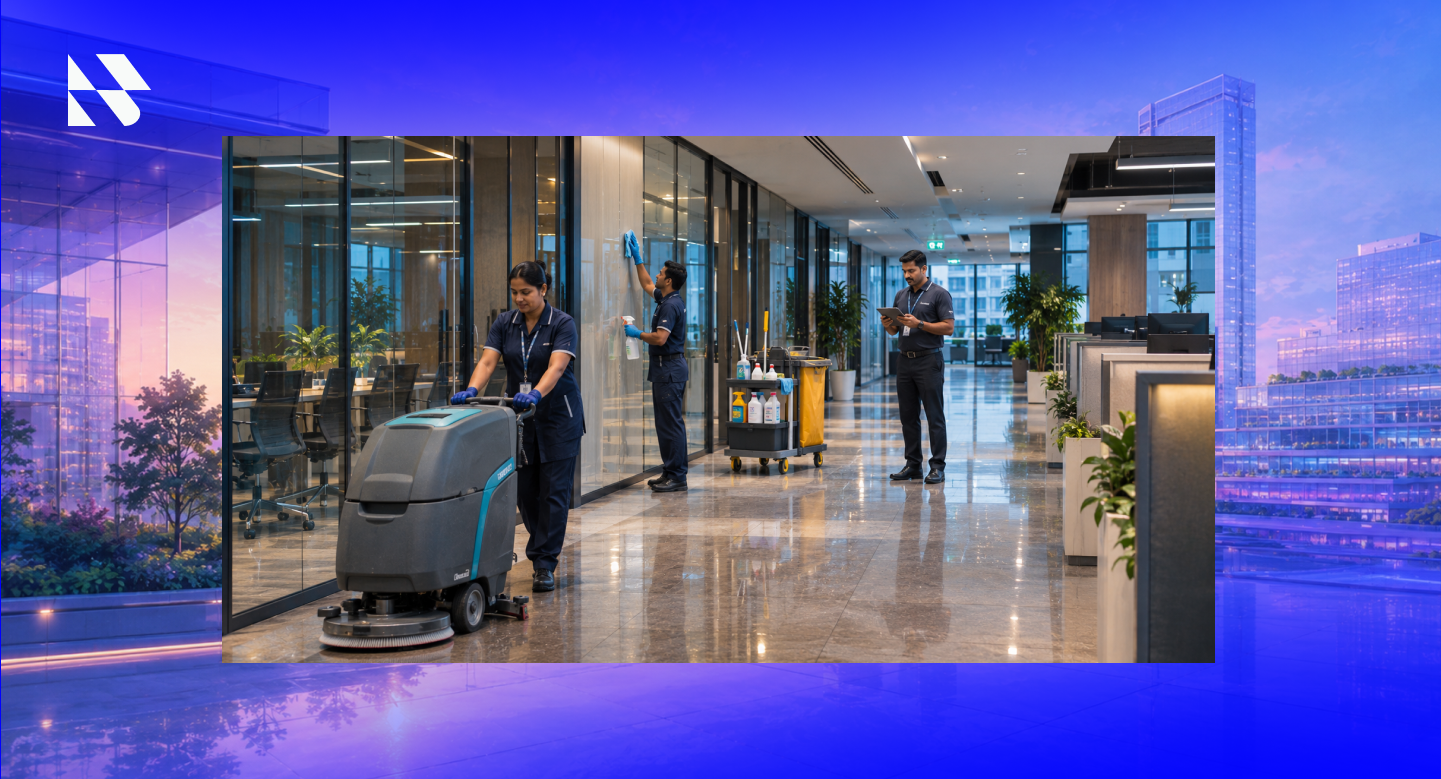
Cleanliness is an essential part of how a commercial facility operates. Offices, corporate campuses, hospitals, educational institutions, and industrial workplaces all require planned cleaning to maintain usable, comfortable, and well-managed environments.
However, selecting a commercial cleaning service provider involves more than comparing prices or checking how frequently a space will be cleaned. Businesses need to understand the scope of work, staffing arrangements, supervision, cleaning procedures, quality checks, and the provider’s ability to meet operational requirements consistently.
Cleaning also needs to work alongside other facility services. When housekeeping, maintenance, waste management, and other activities operate in isolation, coordination gaps can affect the overall workplace experience.
At Bluspring, we view commercial cleaning as an important part of effective facility management. This guide explains what commercial cleaning services include, what businesses should evaluate when selecting a provider, and how cleaning can fit into a broader Integrated Facility Management (IFM) arrangement.
Looking for the Right Commercial Cleaning Partner?
Tell us about your facility’s cleaning requirements and let our team help you identify the right facility management support.
What Are Commercial Cleaning Services?
Commercial cleaning services involve the planned cleaning, housekeeping, and upkeep of business premises and operational facilities. These services are delivered according to the nature of the property, how its spaces are used, the number of occupants, and the hygiene requirements of the environment.
Unlike occasional or residential cleaning, commercial cleaning generally follows defined schedules, assigned responsibilities, and documented procedures. A service provider may deploy housekeeping personnel, supervisors, equipment, and cleaning materials to maintain agreed areas throughout the contract period.
The scope can vary considerably between facilities. An office may require daily cleaning of workstations, meeting rooms, washrooms, and common areas. A healthcare environment may require more specific cleaning and disinfection procedures. Industrial facilities may need cleaning arrangements that account for operational activity, equipment, floor conditions, and site-specific safety requirements.
The objective is to establish a consistent cleaning programme that supports the facility’s daily operations without disrupting the people who use it.
What Do Commercial Cleaning Services Include?
Commercial cleaning requirements depend on the facility and the agreement between the business and its service provider. A well-defined scope should identify the areas covered, tasks to be completed, cleaning frequency, and responsibilities for each activity.
Common service components include the following.
Office and Workplace Cleaning
Office cleaning services help maintain the spaces employees, visitors, and business partners use every day. Typical activities include:
- Cleaning workstations, desks, and frequently touched surfaces.
- Sweeping, mopping, and vacuuming floors.
- Cleaning meeting rooms, conference areas, and reception spaces.
- Maintaining pantry and cafeteria areas.
- Emptying waste bins and managing routine waste collection.
- Cleaning glass partitions, doors, and accessible surfaces.
- Replenishing agreed washroom and hygiene supplies.
Cleaning schedules should reflect how the workplace is used. Reception areas and meeting rooms may need attention throughout the day, while certain tasks can be completed before or after regular working hours.
Industrial and Operational Facility Cleaning
Industrial cleaning requirements differ from those of a conventional office. Warehouses, manufacturing facilities and other operational environments may have specific cleaning needs arising from machinery, material movement, production schedules and site safety requirements.
Depending on the facility and agreed scope, cleaning activities may include:
- Maintaining floors, walkways and designated operational areas.
- Removing routine dust, dirt and accumulated waste.
- Cleaning common areas and employee facilities.
- Maintaining housekeeping standards around storage and movement zones.
- Coordinating cleaning activities with site operations to avoid unnecessary disruption.
Businesses should distinguish routine industrial housekeeping from specialist cleaning. Activities involving hazardous substances, confined spaces, specialised equipment or specific industrial processes may require additional expertise, procedures and approvals. These responsibilities should be clearly identified before the contract is finalised.
Hospitals and Healthcare Facility Cleaning
Hospitals, clinics and other healthcare facilities require cleaning procedures that account for patient care, staff activities, visitor movement and infection prevention requirements. Cleaning arrangements should follow the facility’s hygiene protocols and distinguish between general housekeeping and specialised clinical-area cleaning.
Depending on the agreed scope, activities may include:
- Cleaning and disinfecting waiting areas, reception spaces and administrative offices.
- Maintaining patient rooms, corridors and common areas.
- Cleaning washrooms and replenishing hygiene supplies.
- Following designated cleaning procedures for high-touch surfaces.
- Segregating and handling waste according to applicable healthcare waste management requirements.
Healthcare providers should ensure that cleaning personnel receive appropriate site-specific training and understand access restrictions, approved cleaning materials and procedures for different areas. Specialist clinical cleaning and biomedical waste handling should only be included where the provider has the necessary capabilities and authorisations.
Educational Institution Cleaning
Schools, colleges and universities require cleaning arrangements that accommodate student schedules, classroom usage, staff activities and visitor movement. Cleaning programmes should maintain hygienic learning environments while minimising disruption to academic activities.
Depending on the institution and agreed scope, activities may include:
- Cleaning classrooms, laboratories and libraries.
- Maintaining administrative offices and staff rooms.
- Cleaning corridors, staircases and common areas.
- Maintaining washrooms and replenishing hygiene supplies.
- Cleaning cafeterias, dining areas, and shared facilities.
- Maintaining indoor sports areas and other student amenities.
Cleaning schedules can be aligned with class timings, breaks, weekends, and academic holidays. Laboratories, kitchens, and specialised learning spaces may require additional procedures based on their use and safety requirements.
Common-Area and Washroom Maintenance
Common areas receive frequent use and can influence how employees and visitors experience a facility. These spaces need planned attention rather than occasional cleaning.
Typical requirements include maintaining corridors, staircases, lifts, lobbies, waiting areas, washrooms, and shared facilities.
Washroom maintenance may involve cleaning and disinfection, replenishing consumables, checking fixtures, and reporting plumbing or maintenance issues. The frequency of these activities should reflect occupancy, usage patterns, and the facility’s hygiene requirements.
A provider should also explain how it handles complaints, urgent cleaning requests, and situations where an area needs attention outside the regular schedule.
Cleaning Schedules and Periodic Deep Cleaning
A commercial cleaning programme should distinguish between routine tasks and periodic activities.
Daily cleaning may cover workstations, floors, washrooms, and common areas. Weekly or monthly schedules may include more detailed cleaning of selected surfaces, fixtures, storage areas, and other spaces. Periodic deep cleaning may address areas that require additional attention beyond normal housekeeping routines.
The right schedule depends on factors such as:
- Facility size and layout.
- Daily occupancy and visitor movement.
- Type of business activity.
- Nature of flooring, furniture, and surfaces.
- Hygiene and safety requirements.
- Operating hours and access restrictions.
Businesses should agree on these schedules with the provider and review them when occupancy, operations, or facility usage changes.
Why Commercial Cleaning Matters for Business Operations
Commercial cleaning is not simply a matter of appearance. It contributes to the everyday functioning and management of a facility.
Supports workplace hygiene: Regular cleaning and appropriate disinfection procedures help maintain cleaner shared environments. The exact methods should reflect the space, surface type, and applicable hygiene requirements.
Improves the workplace experience: Employees, visitors, and customers interact with reception areas, washrooms, meeting rooms, and common spaces throughout the day. Consistent upkeep helps make these environments more comfortable and presentable.
Supports operational continuity: Poorly maintained areas can create avoidable disruptions. Defined cleaning schedules and clear escalation procedures help businesses address issues before they interfere with routine activities.
Helps manage facility standards: Documented procedures, supervision, and quality inspections give facility managers a basis for checking whether cleaning responsibilities are being fulfilled.
Supports safety and compliance: Cleaning teams need to understand site-specific safety requirements, chemical handling procedures, equipment use, and access restrictions. The provider’s responsibilities should be aligned with the facility’s applicable rules and risk controls.
The value of a cleaning service therefore depends not only on the tasks performed, but also on how reliably those tasks are planned, supervised, and reviewed.
How to Choose a Commercial Cleaning Service Provider
Choosing a commercial cleaning company requires a structured assessment of the facility’s needs and the provider’s ability to meet them. The following areas can help businesses compare service providers more effectively.
Assess Your Facility’s Cleaning Requirements
Start by identifying what needs to be cleaned, how often, and under what operating conditions.
A provider cannot prepare an accurate scope or deployment plan without understanding the facility. Document the areas covered, approximate floor area, occupancy, operating hours, access arrangements, and any specialised cleaning requirements.
For multi-location businesses, also consider whether cleaning standards need to remain consistent across different sites. Some locations may require different schedules or procedures based on their use.
Before requesting proposals, clarify:
- Which areas are included and excluded?
- What tasks are required in each area?
- How frequently must each task be completed?
- Are there peak-hour or restricted-access requirements?
- Are specialist cleaning activities part of the scope?
- Who is responsible for consumables, equipment and waste disposal?
This information gives providers a common basis for preparing and pricing their proposals.
Evaluate Staffing, Training and Supervision
The quality of commercial housekeeping services depends on how personnel are deployed, trained, and supervised.
Ask providers how they determine staffing requirements for your facility. The answer should account for the cleaning scope, site layout, operating hours, task frequency, and expected service levels rather than relying only on a generic manpower estimate.
Also review their approach to:
- Induction and site-specific training.
- Safe use of cleaning chemicals and equipment.
- Personal protective equipment requirements.
- Attendance and replacement arrangements.
- Supervisor responsibilities and inspection frequency.
- Escalation of complaints and service issues.
For large or multi-location facilities, understand how supervisors coordinate teams across shifts and locations. Clear reporting lines help facility managers identify who is responsible when a task is missed, or a service issue remains unresolved.
Review Cleaning Procedures and Quality Checks
A commercial cleaning provider should be able to explain how it maintains consistent service standards.
Ask for documented cleaning procedures relevant to your facility. These should identify the tasks, approved methods, cleaning frequencies, and responsibilities for different areas.
Quality checks are equally important. Businesses should understand how inspections are conducted, how missed tasks are recorded, and how corrective actions are followed up.
Useful questions include:
- Are cleaning checklists maintained for each area?
- How frequently are inspections conducted?
- Who verifies completed tasks?
- How are complaints recorded and resolved?
- Can the provider share inspection reports?
- How are recurring service failures addressed?
Do not rely only on a provider’s general promise of quality. Look for a process that allows your team to verify service delivery.
Understand Equipment, Supplies and Responsibilities
The proposal should clearly explain what the provider will supply and what the client must make available.
This includes cleaning equipment, tools, chemicals, consumables, protective equipment and storage arrangements. Where specialist equipment is required, confirm whether it is included in the contract or charged separately.
Businesses should also review the provider’s approach to chemical selection, storage, dilution, labelling and safe handling. Cleaning materials should be suitable for the surfaces and environment in which they will be used.
Clarify who is responsible for:
- Procurement and replenishment of cleaning materials.
- Equipment maintenance and replacement.
- Washroom and hygiene consumables.
- Waste collection and disposal.
- Storage space and access to utilities.
- Any additional equipment needed for periodic cleaning.
Documenting these responsibilities helps prevent disagreements during service delivery.
Compare Service-Level Agreements and Reporting
A Service-Level Agreement (SLA) should translate the cleaning scope into measurable service expectations.
Rather than using broad statements such as “maintain cleanliness”, define what the provider is expected to deliver and how performance will be assessed.
Depending on the facility, relevant measures may include:
- Completion of scheduled cleaning activities.
- Inspection scores against agreed standards.
- Response time for urgent cleaning requests.
- Washroom inspection and replenishment compliance.
- Complaint acknowledgement and resolution.
- Completion of corrective actions within agreed timelines.
Also review the reporting process. Understand how frequently performance reports will be shared, who will review them, and how unresolved issues will be escalated.
A clear SLA gives both parties a common reference point for managing performance throughout the contract.
Outsourced Commercial Cleaning vs. In-House Teams
Businesses can manage cleaning through their own employees or appoint an external commercial cleaning service provider. The right arrangement depends on the size of the facility, the complexity of the cleaning requirements and the organisation’s ability to manage the function internally.
An in-house team gives businesses direct control over recruitment, deployment, schedules and daily supervision. However, the organisation also takes responsibility for staffing, training, equipment, supplies, attendance management and service quality.
Outsourced commercial cleaning transfers agreed delivery responsibilities to a service provider. The provider manages the resources and activities defined in the contract, while the business retains oversight of service expectations and performance.
Outsourcing may be useful when businesses need specialised operational support, flexible staffing arrangements, or cleaning services across multiple locations. It does not remove the need for supervision, clear SLAs, or contract management.
For a more detailed comparison, read our guide to In-House vs Outsourced Facility Management.
What Should a Commercial Cleaning Contract Include?
A commercial cleaning contract should define the service arrangement clearly enough for both parties to understand their responsibilities.
Before signing, review whether it covers the following:
- Scope of services: List the facilities, areas, tasks, and activities included in the agreement, along with any exclusions.
- Cleaning schedules: Specify the frequency, timing, and duration of routine and periodic cleaning activities.
- Staffing and supervision: Define deployment expectations, training responsibilities, supervisory arrangements, and replacement procedures.
- Equipment and consumables: Identify who supplies, maintains, and replaces cleaning equipment, chemicals, and consumables.
- SLA and performance measures: Establish inspection standards, reporting frequency, response times, and corrective-action requirements.
- Health, safety and compliance: Document applicable site rules, chemical-handling requirements, protective equipment and safety responsibilities.
- Pricing and additional charges: Clarify the pricing structure, payment terms, taxes and charges for work outside the agreed scope.
- Escalation and dispute resolution: Identify contact points and procedures for handling complaints, service failures and disagreements.
- Contract duration and exit terms: Specify the contract period, renewal conditions, termination notice and handover responsibilities.
- Scope-change process: Explain how changes in facility size, occupancy, operating hours or service requirements will be assessed and approved.
The contract should also explain how additional or specialist cleaning requirements will be quoted and authorised. This reduces the risk of unexpected charges and disagreements over what the original scope covers.
Commercial Cleaning as Part of Integrated Facility Management
Cleaning is closely connected to other activities that keep a commercial facility operational. Housekeeping teams may need to coordinate with maintenance personnel, security teams, waste management providers, and facility administrators to complete their work safely and efficiently.
For example, a cleaning issue may require technical maintenance if it is caused by a plumbing leak or damaged building fixture. Waste collection schedules may need to align with housekeeping activities, while access to restricted areas may require coordination with security teams.
When these functions are managed separately, facility teams may need to coordinate different providers, reporting processes and escalation channels.
An Integrated Facility Management approach brings agreed facility services under a coordinated operating arrangement. This can help businesses establish clearer responsibilities, align service schedules and manage performance across related functions.
Our article on Single-Vendor vs Multi-Vendor Facility Management explains how businesses can assess the benefits and considerations of these operating models.
How Bluspring Supports Facility Management Requirements
At Bluspring, we provide Integrated Facility Management services that bring together soft services, technical/MEP support, and other facility requirements under a coordinated operating approach.
Our soft services include housekeeping and cleaning, alongside related capabilities such as pest control and landscaping. We support different operating environments, including corporate spaces, healthcare facilities, educational institutions and industrial settings, with service arrangements shaped around the requirements of each facility.
We focus on understanding the scope of work, defining operational responsibilities and coordinating the services required to keep facilities clean, functional and well managed.
Technology also supports our approach to facility operations. Our Smart Operations platform gives our IFM teams real-time visibility into facility activities, helping support coordination and operational oversight.
For businesses evaluating commercial cleaning services, this broader capability matters when cleaning is one part of a larger facility management requirement. Instead of assessing housekeeping in isolation, organisations can consider how it needs to work alongside technical services and other operational functions.
Bring Your Facility Services Under One Coordinated Approach
From commercial cleaning to technical maintenance, discuss how Bluspring can support your wider facility management requirements.
Frequently Asked Questions (FAQ)
What is included in commercial cleaning services?
Commercial cleaning services typically include office and workplace cleaning, housekeeping, floor care, washroom maintenance, common-area cleaning, waste handling, and periodic deep cleaning. The exact scope depends on the facility, its operating requirements, and the agreement with the service provider. Some environments may also require specialised cleaning procedures.
How much do commercial cleaning services cost?
Commercial cleaning costs depend on the facility’s size, location, cleaning frequency, staffing requirements, operating hours, equipment, and consumables. Specialist cleaning requirements can also affect the price.
Businesses should request a proposal based on a clearly documented scope rather than compare headline prices alone. A lower quotation may exclude important tasks, supplies, or supervision requirements that affect the overall cost of service delivery.
Should businesses outsource commercial cleaning?
Outsourcing can be suitable for businesses that want an external provider to manage agreed cleaning activities, staffing, and operational resources. It may also help organisations coordinate cleaning across multiple locations.
However, outsourcing does not remove the need for internal oversight. Businesses should define the scope, establish SLAs, review performance, and retain clear escalation channels.
How often should a commercial facility be cleaned?
Cleaning frequency depends on occupancy, facility type, usage patterns, hygiene requirements, and operating hours. High-traffic areas and washrooms may require attention several times a day, while other spaces may follow daily or periodic schedules.
Businesses should develop cleaning plans based on actual usage and review them when operating conditions change.
What should businesses look for in a commercial cleaning company?
Businesses should evaluate the provider’s experience with similar facilities, staffing and supervision arrangements, cleaning procedures, equipment, safety practices, quality inspections, reporting and SLA commitments. They should also check whether the provider can accommodate changes in occupancy, operating hours and service requirements.
The most suitable provider is one that can demonstrate how it will deliver, supervise and report on the agreed scope, not simply offer the lowest price.
Looking for a Commercial Cleaning Partner?
At Bluspring, we bring housekeeping and cleaning together with wider facility management capabilities. Share your requirements with our team to discuss the right support for your workplace or operational facility.