
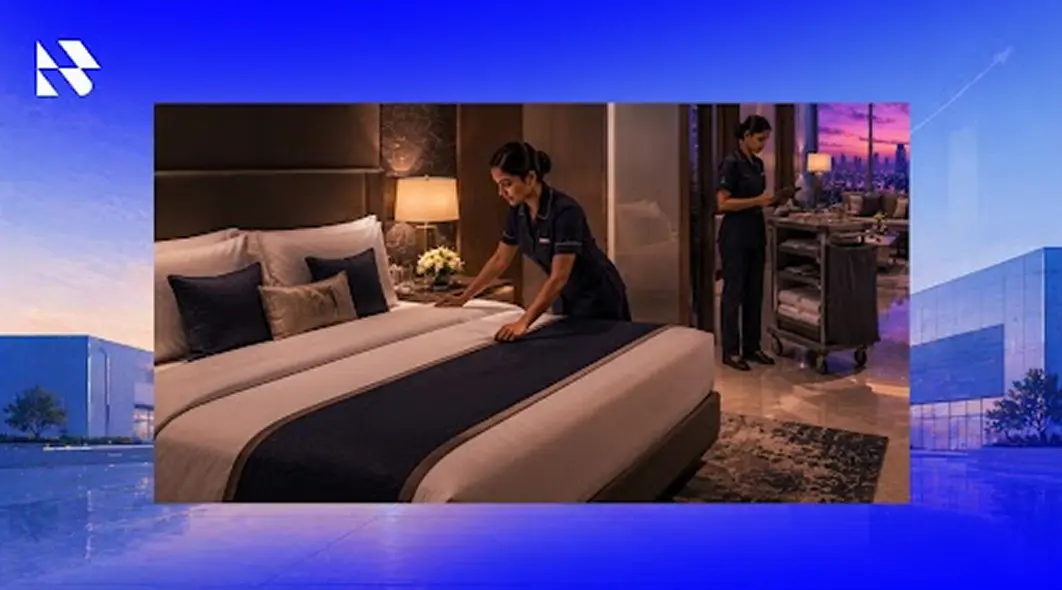
Hospitality-grade housekeeping differs from standard corporate housekeeping in intensity, inspection rigour, and staff training: it treats every guest-facing space, a guest house, an executive residence, an event venue, the way a five-star hotel treats a guest room, not the way an office treats a workstation. For hospitality and admin managers overseeing spaces where visitors, executives, or guests will actually stay or spend extended time, that distinction is not a matter of degree. It is a different service model entirely, built around presentation, consistency, and an inspection discipline that routine office cleaning was never designed to meet.
Many organisations discover this gap the hard way — by applying their existing office housekeeping contract to a newly acquired guest house or executive residence, only to find that a service perfectly adequate for open-plan office floors looks visibly under-delivered in a space meant to feel like a hotel suite. The issue is rarely effort; it is that standard housekeeping and hospitality-grade housekeeping are trained, inspected, and resourced differently from the ground up, and one cannot simply be scaled up into the other without deliberate redesign.
What Distinguishes Hospitality-Grade Housekeeping
Standard corporate housekeeping is built around throughput and hygiene: clean floors, empty bins, sanitised washrooms, delivered efficiently across a large footprint on a fixed schedule. It is judged by the absence of visible dirt and the consistency of a baseline standard across many similar spaces.
Hospitality-grade housekeeping is judged differently — by presentation, not just cleanliness. A guest room or executive residence needs to look and feel deliberately arranged, not merely tidied: linens folded and positioned precisely, amenities replenished and presented rather than simply restocked, and every visible surface treated as part of the guest’s first impression rather than a maintenance checklist item. The difference shows up most clearly in what each standard tolerates. Standard housekeeping tolerates a slightly uneven cushion arrangement or an amenity tray that’s functional but not styled. Hospitality-grade housekeeping does not, because in a guest-facing space those details are the standard, not a bonus.
This also changes the pace and attention per space. A standard office cleaning round covers a large area quickly, prioritising coverage. Hospitality-grade housekeeping slows down per room or per space, prioritising precision — because the space will be experienced closely, by one or a small number of people, rather than passed through by hundreds.
Why Guest-Facing Spaces Demand a Different Service Intensity
Guest houses, executive housing, and event venues share a characteristic that ordinary office space doesn’t: the person using the space is often staying in it, hosting others in it, or forming a lasting impression of the organisation through it, rather than simply passing through.
Guest houses accommodate visiting executives, clients, or delegations for extended stays, sometimes multiple nights. The housekeeping standard needs to hold up not just for a single walkthrough but across a stay — turndown-quality service, consistent daily upkeep, and attentiveness to details a hotel guest would expect but an office visitor wouldn’t think to look for.
Executive housing serves senior leadership living arrangements, where housekeeping is not an occasional service but a continuous standard the resident experiences daily. Consistency matters enormously here: a lapse noticed once is a lapse noticed by someone with the visibility to raise it directly.
Event venues host functions where the space is on display to a concentrated audience for a defined window — board meetings, investor events, celebrations — and where housekeeping has to deliver a guest-ready presentation on a tight, non-negotiable timeline before the event begins, with no room for a next-day correction.
In each of these settings, a lapse in housekeeping standard is not just a hygiene issue — it is a visible, personal experience for someone whose opinion of the organisation matters disproportionately, whether that’s an executive, an investor, or a guest delegation.
Core Scope: What Hospitality-Grade Housekeeping Includes
A hospitality-grade housekeeping programme is built around three coordinated elements that don’t typically appear in a standard corporate housekeeping scope:
- Turndown-style service standards — evening or scheduled service that goes beyond daytime tidying: beds prepared to a hotel standard, amenities refreshed, and the space reset for the next period of use, modelled on hospitality-industry turndown service rather than a single daily clean
- Linen and amenity management — a defined inventory and rotation standard for linens, towels, and guest amenities, ensuring fresh, correctly presented items are always available rather than managed reactively when supplies run low
- Guest-ready inspection checklists — a formal, itemised inspection completed before a space is signed off as guest-ready, covering presentation details (folding, alignment, amenity placement) that a standard office cleaning inspection wouldn’t include, because a standard inspection isn’t designed to catch them
These three elements work together to create a repeatable standard rather than a one-off effort. Turndown-style service sets the baseline expectation, linen and amenity management ensures the physical inputs are always available to meet it, and the inspection checklist verifies the standard was actually delivered before anyone experiences the space — the same quality-assurance logic a hotel applies before a guest checks in.
Guest-facing spaces such as executive housing and guest houses are held to a hospitality-grade housekeeping standard that goes beyond routine office cleaning, closer to five-star protocol than to standard soft services.
Staff Training: Why This Standard Requires Separate Skills
Delivering hospitality-grade housekeeping requires training that standard corporate housekeeping staff typically don’t receive. Presentation techniques — precise linen folding, amenity styling, room arrangement to a visual standard — are hospitality-industry skills, closer to what a hotel housekeeping team learns than what an office cleaning crew is trained on. Staff also need a different sense of pacing and attentiveness: hospitality-grade work rewards slowing down to get details right in a smaller number of spaces, where standard housekeeping rewards efficient coverage across a larger area.
Inspection discipline is equally important. Hospitality-grade housekeeping teams need to be trained to self-inspect against a guest-ready checklist before handover, catching the kind of detail — an amenity slightly out of place, a linen fold that’s functional but not precise — that a guest or executive would notice immediately, even if it would pass unnoticed in a standard office setting. Without this training, staff accustomed to standard housekeeping norms will deliver a clean space that still falls short of a hospitality-grade presentation standard, because clean and guest-ready are not the same evaluation.
How Bluspring’s Hospitality Vertical Trains Its Housekeeping Teams to This Standard
Bluspring trains housekeeping staff assigned to guest houses, executive housing, and event venues to the hospitality-grade standard described above, rather than applying the same training and inspection framework used for standard office soft services. This includes turndown-style service protocols, linen and amenity management discipline, and guest-ready inspection checklists specific to each type of space. Because this hospitality-grade housekeeping capability sits within Bluspring’s broader integrated facility management platform, it can be deployed consistently alongside a client’s existing soft services and executive housing arrangements, rather than sourced as a separate specialist vendor. For hospitality and admin managers responsible for spaces where presentation genuinely matters, that combination of dedicated training and integration with the wider facility management relationship is what keeps the standard consistent, visit after visit, rather than dependent on which individual staff member happens to be on duty.
Frequently Asked Questions (FAQ)
What is hospitality-grade housekeeping?
Hospitality-grade housekeeping is a service standard modelled on five-star hotel practice — precise presentation, turndown-style service, and formal guest-ready inspection — applied to guest-facing spaces like guest houses, executive residences, and event venues.
How is it different from standard corporate housekeeping?
Standard corporate housekeeping prioritises coverage, hygiene, and efficient throughput across a large footprint, while hospitality-grade housekeeping prioritises presentation and precision in a smaller number of spaces, judged against a guest-ready standard rather than a cleanliness baseline.
What standards apply to guest house and executive housing cleaning?
Guest house and executive housing cleaning typically follows turndown-style service standards, defined linen and amenity management protocols, and formal inspection checklists that verify presentation details before the space is used, not just that it has been cleaned.
Why does hospitality housekeeping need separate training?
Hospitality housekeeping needs separate training because presentation techniques, pacing, and self-inspection discipline are distinct hospitality-industry skills that standard office housekeeping training doesn’t cover, and the gap between “clean” and “guest-ready” is easy to miss without it.
Where is hospitality-grade housekeeping typically applied?
It is typically applied to guest houses, executive housing and senior leadership residences, and event venues — any guest-facing space where visitors or executives experience the space closely and where presentation reflects directly on the organisation.