
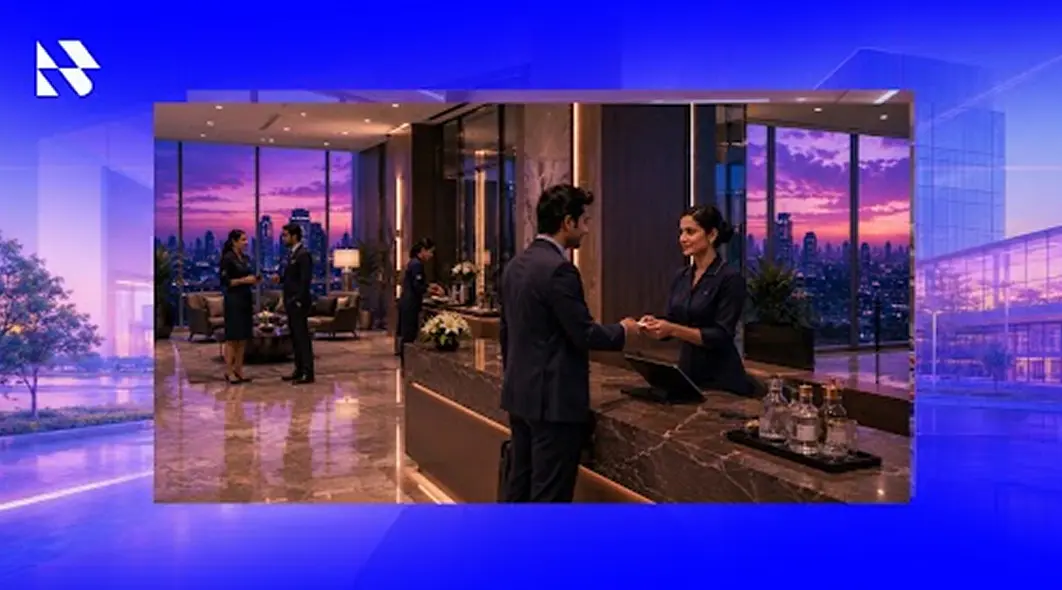
Guest relations within corporate hospitality covers everything a visitor experiences from the moment they arrive at a facility to the moment they leave — welcome protocols, front-desk coordination, refreshment and amenity standards, and the etiquette and presentation of the staff who represent the organisation at that first point of contact. For admin and HR heads who treat visitor experience as a measurable extension of company brand, guest relations is not a soft add-on to facility management; it is the layer of service that determines what an investor, client, or board member remembers about an organisation before a single business conversation begins.
Most enterprises invest heavily in the parts of the visitor journey they can control directly — the office design, the meeting room technology, the polish of the presentation deck. The human layer of that journey, the actual welcome and hospitality a visitor receives, is frequently left to whichever front-desk or security staff happen to be on duty, without a defined standard or dedicated training. That gap is where guest relations as a discipline earns its place: it treats the welcome experience with the same intentionality an organisation already applies to its physical space and its client-facing materials.
Why the Visitor Experience Is a Brand Touchpoint
Every enterprise spends significant effort on brand perception in its marketing, its offices, and its digital presence. That same discipline rarely extends to the few minutes a visitor spends at reception, waiting for an escort, or being served refreshments in a meeting room — even though those minutes are often the most direct, unfiltered impression a visitor forms of the organisation.
Every enterprise spends significant effort on brand perception in its marketing, its offices, and its digital presence. That same discipline rarely extends to the few minutes a visitor spends at reception, waiting for an escort, or being served refreshments in a meeting room — even though those minutes are often the most direct, unfiltered impression a visitor forms of the organisation.
Investor visits. An investor walking into a facility for due diligence or a site visit is forming an impression that extends beyond the numbers in the boardroom. A disorganised welcome, an unbriefed front desk, or a visibly untrained hospitality staff signals something about operational discipline that no financial presentation can fully offset.
Client meetings. For B2B enterprises, a client visiting a corporate office or facility is often evaluating the relationship as much as the specific meeting agenda. Consistent, polished front-of-house service reinforces the same reliability the client is buying into contractually.
Board members and senior leadership visits. Internal visits from board members or senior leadership carry their own protocol expectations — a level of formality, discretion, and coordination that a standard front-desk experience isn’t designed to deliver, and that requires deliberate training rather than general hospitality instinct.
In each case, the visitor experience is not incidental to the business relationship — it is a data point the visitor uses, consciously or not, to calibrate their confidence in the organisation.
Core Scope: What Corporate Guest Relations Actually Covers
A structured guest relations programme typically spans four coordinated areas:
- Welcome protocols — a defined sequence for greeting a visitor, verifying their appointment, and initiating the visit, designed to feel warm and unhurried even when reception volume is high, rather than transactional or improvised
- Hospitality etiquette training — staff trained specifically in corporate hospitality norms: posture, tone, discretion, and the ability to read a visitor’s expectations (a walk-in vendor meeting calls for a different register than an investor delegation)
- Coordination with security and front office — guest relations does not operate in isolation; a visitor’s badge issuance, escort, and access need to be seamlessly coordinated with security protocols so the welcome experience doesn’t stall at a hand-off between teams
- Refreshment and amenity standards — consistent, well-presented refreshment service in meeting rooms and waiting areas, scaled appropriately to the visitor’s seniority and the nature of the meeting, without requiring ad hoc requests from hosting staff
These four areas function as one system rather than four separate checklists. A polished welcome protocol undermined by an uncoordinated security hand-off, or excellent hospitality training paired with inconsistent refreshment service, still produces a visitor experience with a visible gap — which is why guest relations needs to be managed as a single coordinated programme, not a collection of individually well-intentioned efforts.
Welcome Protocols in Practice
A well-designed welcome protocol begins before the visitor arrives — with the front desk briefed on who is expected, at what time, and for what purpose, so the greeting is personalized rather than generic. On arrival, the sequence typically moves through a warm, unhurried greeting, efficient verification and badge issuance, and a clear handover to whoever is escorting the visitor further into the facility, with no gaps where the visitor is left waiting without acknowledgement. The goal is a welcome that feels considered rather than procedural, even though the procedure behind it is precisely what makes that feel possible.
Hospitality Etiquette Training
Front-of-house staff in a corporate setting need training that goes beyond general customer service — they need to understand the specific register corporate hospitality calls for: professional warmth without over-familiarity, discretion around confidential visits, and the judgement to adjust tone and formality based on who is walking through the door. This is a distinct skill set from retail or hospitality-industry customer service, because the audience, the stakes, and the expected formality are different. Training typically covers posture and presentation, verbal and non-verbal etiquette, handling of VIP and dignitary visits, and coordination protocols so staff know exactly how to escalate or hand off a visitor smoothly.
Coordination with Security and Front Office
Guest relations succeeds or fails on how well it integrates with the teams around it. A visitor’s experience is only as smooth as the coordination between the hospitality staff who greet them, the security team managing access and badging, and the front office or admin team confirming appointments and escorts. Where these functions operate in silos — hospitality staff unaware of a security hold, or security unaware of a scheduled VIP arrival — the visitor experiences the friction directly, even if each individual team performed its own function correctly.
Protocol-driven hospitality service for dignitaries and leadership is a defined standard within Bluspring’s hospitality offering, extending five-star service norms into everyday corporate visitor management.
Refreshment and Amenity Standards
Refreshment service is often the most visible, recurring touchpoint in a guest relations programme, because it happens in nearly every meeting. Consistent standards — in presentation, timing, and appropriateness to the occasion — matter more than elaborate offerings. A well-run programme defines clear service standards scaled to visitor seniority and meeting type, so hosting staff never need to make ad hoc requests or apologise for inconsistent service, and so the same standard holds whether the visitor is a routine vendor or a board-level delegation.
How Bluspring’s Hospitality Vertical Trains Staff to This Standard
Bluspring’s hospitality vertical trains front-of-house staff specifically for the corporate guest relations standard described above — welcome protocols, etiquette calibrated to corporate settings, coordinated handoffs with security and front office, and consistent refreshment and amenity service. Because this hospitality capability sits within Bluspring’s broader integrated facility management platform, guest relations staff are trained to coordinate directly with the security and soft services teams already managing a client’s site, rather than operating as a disconnected hospitality layer added on top. For admin and HR heads who see visitor experience as a brand responsibility rather than a facilities afterthought, that integration is what turns guest relations from an occasional training exercise into a consistently delivered standard.
That consistency matters most precisely when it is hardest to maintain — during a high-stakes visit, a busy reception period, or an unplanned VIP arrival — which is exactly when a trained, well-coordinated hospitality team demonstrates its value most clearly, and when a gap in preparation is most visible to the visitor experiencing it.
Frequently Asked Questions (FAQ)
What is guest relations in corporate hospitality?
Guest relations in corporate hospitality covers the full visitor experience from arrival to departure — welcome protocols, hospitality etiquette, coordination with security and front office, and refreshment and amenity standards — managed as one coordinated programme rather than separate tasks.
How do enterprises manage front-of-house visitor experience?
Enterprises typically manage front-of-house visitor experience through defined welcome protocols, trained hospitality staff, and close coordination with security and admin teams, ensuring a consistent, well-presented experience regardless of who is visiting or when.
What training do hospitality staff need for corporate settings?
Corporate hospitality staff need training in professional etiquette, discretion, tone calibration for different visitor types, VIP and dignitary protocols, and coordination procedures with security and front office teams, distinct from general retail or hospitality-industry customer service training.
Why does guest experience matter for enterprise brand perception?
Guest experience matters because visitors — investors, clients, board members — form an impression of an organisation’s operational discipline and culture from their welcome experience, often before any formal business discussion takes place.
How is VIP or dignitary hospitality different from standard visitor management?
VIP and dignitary hospitality requires protocol-driven service — heightened formality, discretion, and coordination — extending standards closer to five-star hospitality norms, compared to the more routine welcome process used for everyday visitors.