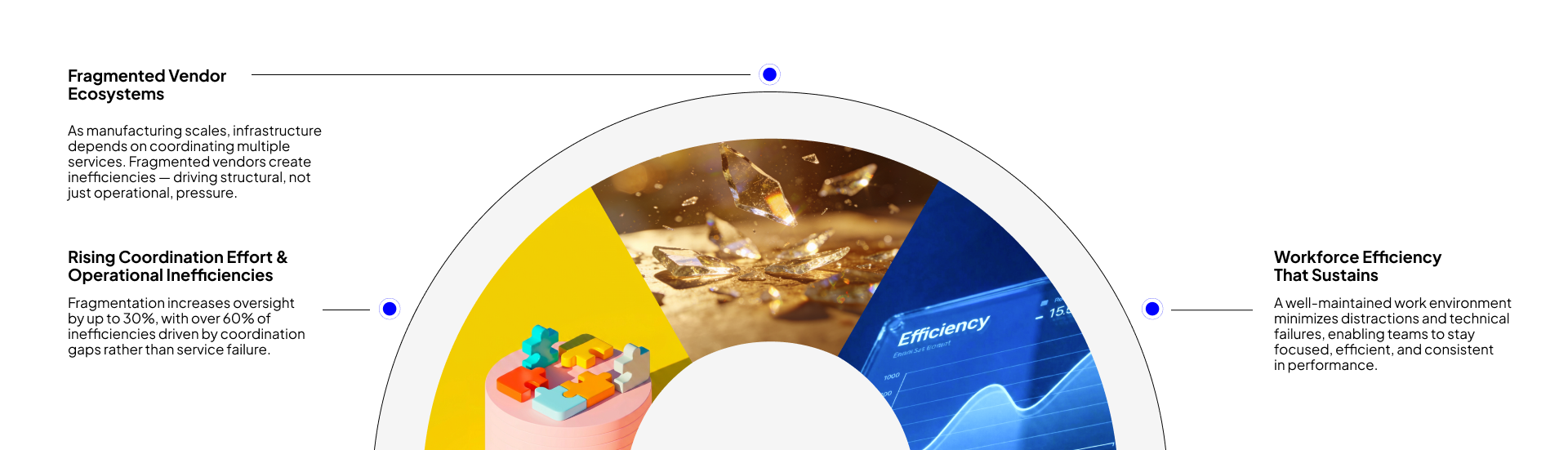
As manufacturing scales, infrastructure depends on coordinating multiple services. Fragmented vendors create inefficiencies – driving structural, not just operational, pressure.
The Shift
Move from Vendor Management to Integrated Infrastructure
Manufacturers are moving beyond vendor fragmentation, unifying infrastructure services under one framework to improve coordination, accountability, and control.
One accountable partner across all services
Unified infrastructure solutions across services, governed by a single reporting and escalation structure with one accountable partner, reducing complexity and improving control.
Aligned Operations, Not Isolated SLAs
Maintenance aligned with uptime goals, security integrates with contractor workflows, housekeeping feeds into compliance outcomes, and cafeteria services support workforce productivity and hygiene standards.
Predictive & Data-Driven Operations
Predictive maintenance helps identify potential failures before they disrupt production — but it delivers real value only when infrastructure operates as an integrated system, not across fragmented vendors.
The Impact
What You Gain
A single, integrated structure unifying payments, compliance, and payments, with one point of contact and cross-functional expertise. Enabling the power of one with consistent delivery, measurable outcomes, and stronger risk control.
FACILITY & ADMIN
Reduced Coordination Effort
Fewer vendors and unified operations simplify management and reduce administrative overhead
FACILITY & ADMIN
Improved Cost Predictability
Integrated infrastructure models can improve cost predictability by 20–25%, enabling better financial planning.
FACILITY & ADMIN
Higher Uptime & Operational Stability
Aligned systems reduce disruptions and support uninterrupted production and operational continuity.
FACILITY & ADMIN
Better Visibility & Control
Integrated operations improve visibility across services, enabling faster decisions and fewer blind spots.
CASE STUDY
MANUFACTURING — CHEMICAL PLANT, GUJARAT
Moved from fragmented guarding to integrated security in 60 days
AI surveillance reduced false alarms by 90%
Smart access control eliminated unauthorized entry
Central command centre for real-time plant-wide visibility
Full audit compliance achieved with automated reporting
We use analytics and essential cookies to run the website and understand how visitors interact with it. By continuing, you agree to our use of cookies.